
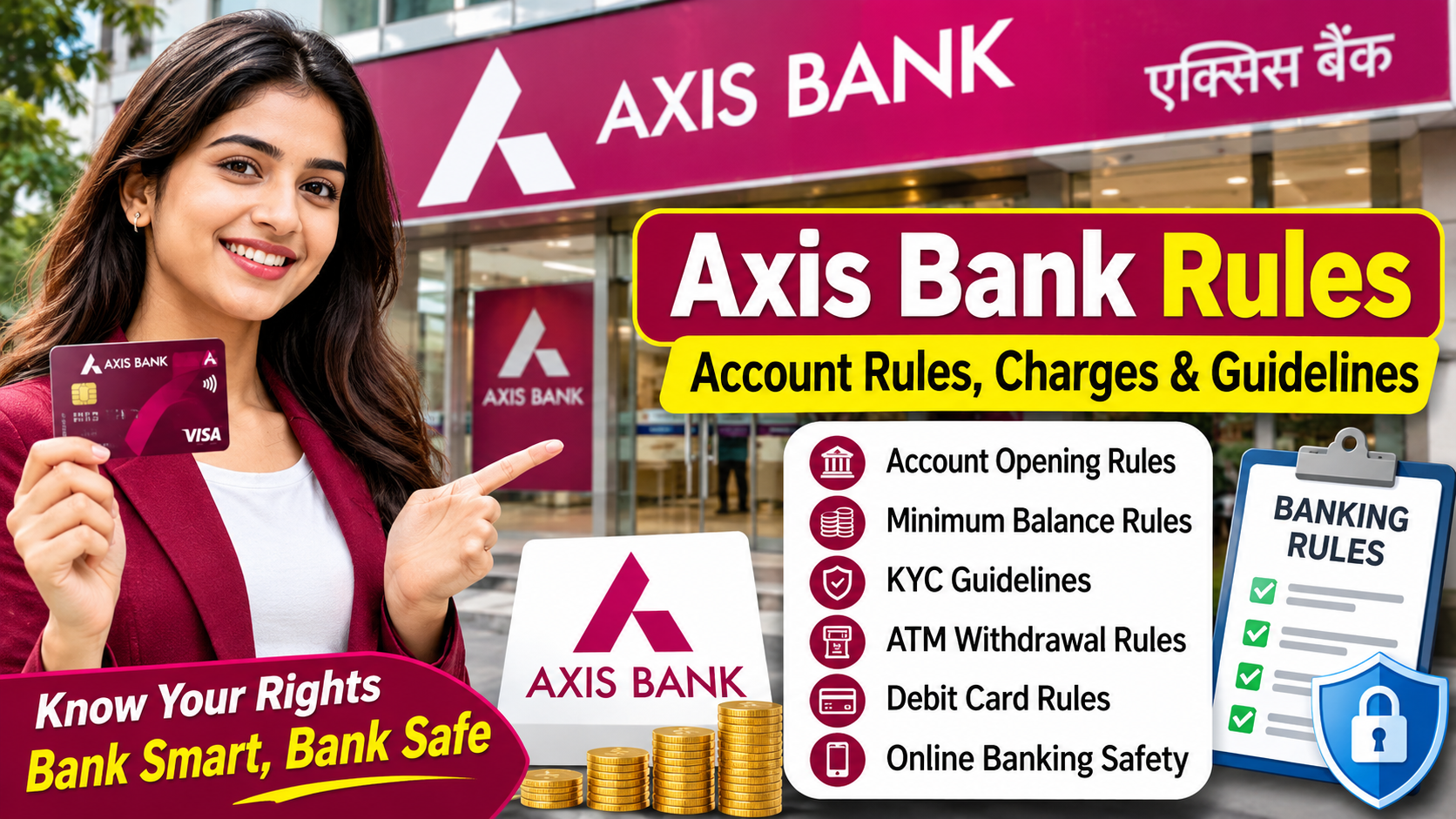
Axis Bank Rules 2026: Account Rules, Minimum Balance, Charges and Important Guidelines
Contents
Axis Bank is one of India’s leading private-sector banks, offering a wide range of financial services, including savings accounts, current accounts, fixed deposits, debit cards, credit cards, personal loans and digital banking facilities. Millions of customers use Axis Bank for their daily financial transactions.
Before opening an account or using banking services, customers should understand the important Axis Bank rules and regulations. These rules help customers manage their money safely, avoid unnecessary charges and enjoy banking services without difficulties.
In this article, we explain the important Axis Bank rules in simple English, including account opening requirements, minimum balance rules, KYC guidelines, ATM transactions, debit card usage and online banking security.
1. Axis Bank Account Opening Rules
Customers who want to open a savings account with Axis Bank must complete the required application and verification process.
Generally, an individual must be an Indian resident aged 18 years or above to independently open a regular savings account. Special account options may be available for minors through a parent or legal guardian.
The following documents are generally required:
- Aadhaar card or another officially valid identity document.
- PAN card or Form 60, where applicable.
- A registered mobile number.
- Address proof, if required.
- Recent photograph, if requested.
Customers can open eligible savings accounts through a bank branch or the official digital account-opening process.
For digital account opening, customers may need to complete Video KYC verification. The bank checks the submitted information before activating the account.
2. Axis Bank Minimum Balance Rules
One of the most important Axis Bank rules concerns maintaining the required average balance in a savings account.
Axis Bank offers different savings account variants, and the minimum balance requirements can vary depending on the account type and location.
Some accounts may require an Average Monthly Balance (AMB), while others may follow different balance conditions.
Customers should remember that:
- Minimum balance requirements depend on the selected account variant.
- Metro, urban, semi-urban and rural account categories may have different requirements.
- Certain accounts may offer alternative balance or fixed deposit conditions.
- Charges may apply if the required balance is not maintained.
Customers should check the latest schedule of charges on the official Axis Bank website before opening an account.
It is important to understand that every Axis Bank savings account does not have the same minimum balance requirement.
3. Axis Bank KYC Rules
KYC stands for Know Your Customer. It is an important banking requirement used to verify the identity and address of customers.
Axis Bank follows applicable Reserve Bank of India (RBI) guidelines for customer verification.
Customers must provide correct personal information and valid documents when opening an account.
The bank may also ask existing customers to complete Re-KYC when their identification details need updating.
Important KYC guidelines include:
- Provide accurate personal information.
- Submit valid identity and address documents.
- Keep your mobile number updated.
- Complete Re-KYC when requested by the bank.
- Respond to verification requests through official banking channels.
Failure to complete required KYC formalities may result in restrictions on certain account services.
4. Axis Bank ATM Withdrawal Rules
Axis Bank provides ATM facilities that allow customers to withdraw cash and access other banking services.
However, ATM transactions may be subject to free transaction limits and applicable charges.
Customers should understand the following rules:
- Use your registered debit card for ATM transactions.
- Enter the correct ATM PIN.
- Avoid sharing your PIN with anyone.
- Check the applicable free transaction limits.
- Understand additional charges for transactions beyond the permitted limits.
ATM withdrawal limits can depend on the debit card variant and account category.
Customers should check their card’s daily cash withdrawal limit before attempting large transactions.
5. Axis Bank Debit Card Rules
Axis Bank issues different types of debit cards depending on the customer’s account and eligibility.
Debit cards can be used for ATM withdrawals, shopping, online payments and other permitted transactions.
Some important debit card rules include:
- Keep your debit card secure.
- Never share your ATM PIN or OTP.
- Do not write your PIN on the card.
- Report a lost or stolen card immediately.
- Check transaction alerts regularly.
- Use official banking channels to manage card settings.
Customers can also manage eligible debit card features through Axis Mobile and Internet Banking.
If an unknown transaction appears on your account, contact the bank immediately through an official channel.
6. Axis Bank Online Banking Rules
Digital banking makes it easier for customers to transfer money, pay bills, check balances and manage their accounts.
Axis Bank provides mobile banking and internet banking services to eligible customers.
Customers should follow these security rules:
- Use the official Axis Bank website and mobile application.
- Never share your login password.
- Do not disclose OTPs to anyone.
- Avoid using public Wi-Fi for financial transactions.
- Always log out after using internet banking on shared devices.
- Avoid clicking suspicious banking links.
Customers should remember that genuine bank representatives do not need their confidential passwords or OTPs to provide normal customer support.
7. Axis Bank UPI and Money Transfer Rules
Axis Bank customers can use eligible digital payment services to transfer money and make payments.
UPI and other payment facilities allow customers to send money conveniently using supported banking applications.
However, customers must follow basic payment security guidelines.
Before making a transaction, always verify the recipient’s details and payment amount.
Important points include:
- Never share your UPI PIN.
- Do not approve unknown payment requests.
- Verify the receiver’s name before transferring money.
- Avoid suspicious QR codes.
- Check your bank statement after important transactions.
Remember that entering a UPI PIN generally authorises a payment; it is not required to receive money.
8. Axis Bank Transaction Charges and Fees
Axis Bank may charge customers for certain banking services.
These charges depend on the account type, debit card variant and services used by the customer.
Possible charges include:
- Non-maintenance of required average balance.
- Debit card annual fees.
- ATM transactions beyond applicable free limits.
- Certain cheque-related services.
- Special banking services.
- Other applicable transaction fees.
GST and other statutory taxes may also apply to eligible banking charges.
Customers should regularly check the official Axis Bank Fees and Charges page to understand the latest applicable fees.
9. Axis Bank Inoperative Account Rules
Customers should also understand the rules regarding inactive and inoperative savings accounts.
According to Axis Bank’s savings account terms and conditions, an account with no customer-induced transactions for two years or more is treated as an inoperative account.
Customers should periodically review their account activity and contact the bank if their account becomes inactive.
Completing the required verification and activation process can help restore eligible banking services.
10. Axis Bank Account Freeze and Closure Rules
Axis Bank may restrict, freeze or close an account under certain circumstances, subject to applicable laws, regulations and account terms.
Possible reasons include:
- Incomplete or outdated KYC information.
- Suspicious or potentially fraudulent transactions.
- Legal or regulatory instructions.
- Incorrect account information.
- Violation of applicable banking terms and conditions.
Customers should respond to genuine verification requests and contact the bank if their account is restricted.
If an account is closed, customers should follow the bank’s applicable procedures for settling outstanding charges and receiving the remaining eligible balance.
11. Important Safety Rules for Axis Bank Customers
Banking security is essential for protecting personal information and money.
Every Axis Bank customer should follow these basic precautions:
- Never share your OTP, PIN or banking password.
- Use strong passwords for digital banking.
- Check SMS and email transaction alerts.
- Report suspicious transactions immediately.
- Do not install unknown applications suggested by strangers.
- Avoid sharing banking information on social media.
- Contact customer support using verified contact details.
Following these precautions can reduce the risk of online banking fraud.
Conclusion
Understanding Axis Bank rules is important for every customer who wants to use banking services safely and efficiently. From account opening and minimum balance requirements to KYC verification, ATM withdrawals, debit cards and online banking, customers should understand the terms associated with their particular account.
The most important thing is to maintain accurate KYC information, follow digital banking safety guidelines and check the latest applicable charges.
Axis Bank account rules and fees may change depending on the banking product and official policy updates. Therefore, customers should always visit the official Axis Bank website or contact an authorised bank representative for the latest information.
By following these Axis Bank rules, customers can manage their accounts responsibly and enjoy a safer banking experience.