
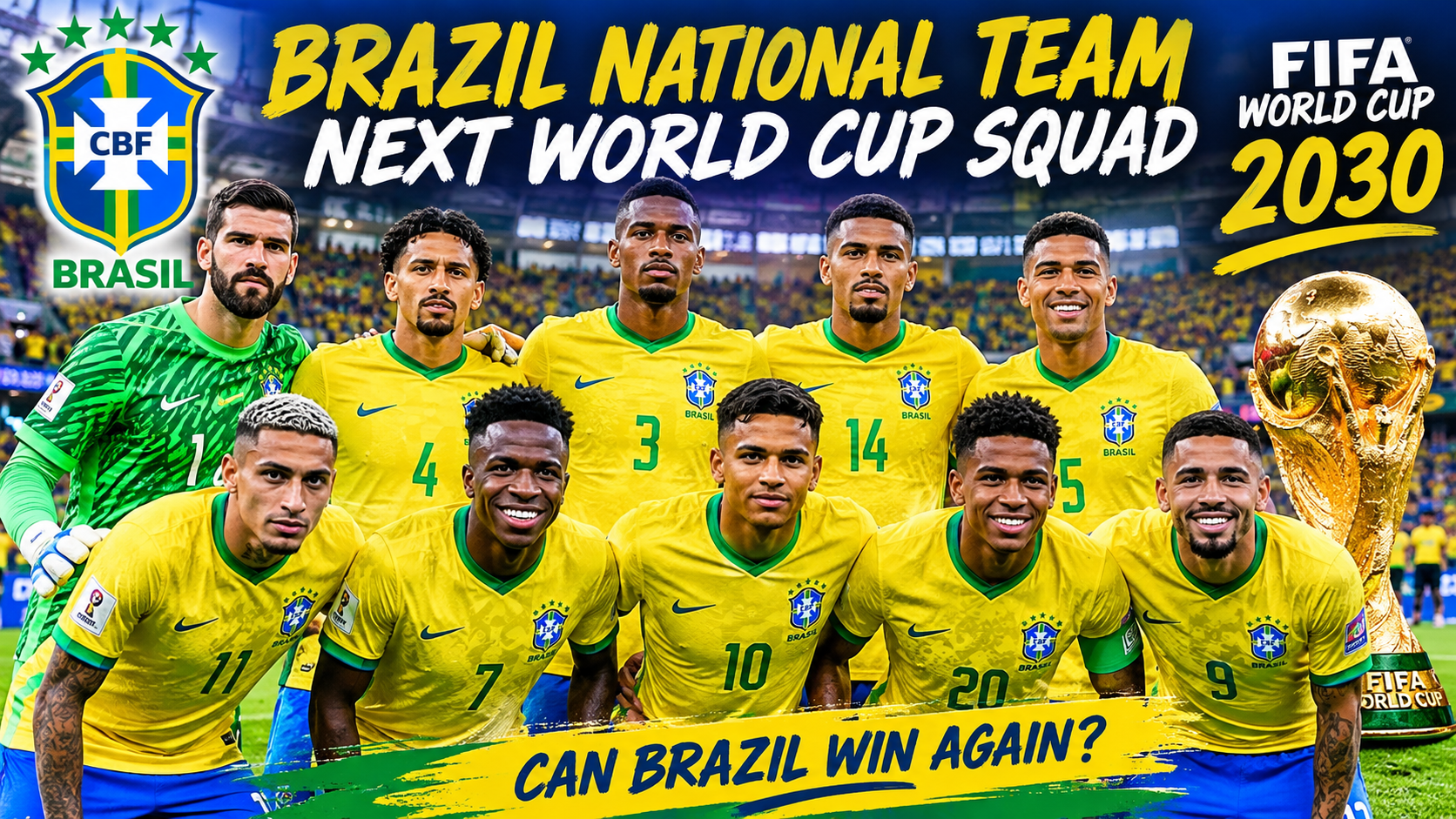
Brazil National Football Team Next World Cup Squad: Predicted Players, Key Stars and Team Analysis
Contents
Brazil is one of the most successful national football teams in history. Known for its attacking football, creative midfielders and world-class forwards, Brazil always enters the FIFA World Cup with high expectations. The Seleção has won the FIFA World Cup five times and remains one of the biggest names in international football.
The next FIFA World Cup after the 2026 tournament is scheduled for 2030. Brazil will aim to build a strong squad featuring experienced international players and exciting young talents. Although the official 2030 squad has not been announced, several Brazilian footballers could become important candidates.
Brazil National Team Predicted Squad for the 2030 FIFA World Cup
Important: The following is an early predicted squad, not an officially confirmed World Cup selection. Players’ form, fitness, age and club performances could change before 2030.
1. Predicted Brazil squad – 26 players
| Position | Predicted players |
|---|---|
| Goalkeepers | Hugo Souza, Pedro Morisco, Otávio |
| Defenders | Marquinhos, Gabriel Magalhães, Éder Militão, Bremer, Yan Couto, Vanderson, Guilherme Arana, Carlos Augusto |
| Midfielders | Bruno Guimarães, Andrey Santos, João Gomes, Éderson, Douglas Luiz, Breno Bidon, Gabriel Bontempo |
| Forwards | Vinícius Júnior, Raphinha, Rodrygo, Endrick, Estêvão, João Pedro, Rayan, Vitor Roque |
These names are possible candidates for the next World Cup cycle, rather than a guarantee that all 26 will be selected.
2. Key players to watch
Vinícius Júnior
Vinícius Júnior could be one of Brazil’s biggest attacking stars in 2030. His speed, dribbling, creativity and ability to score important goals make him an important player for the national team. If he maintains his fitness and performance, he could become one of Brazil’s main leaders.
Endrick
Endrick is one of the most exciting young Brazilian forwards. He has excellent attacking instincts, powerful shooting and the ability to create scoring opportunities. The 2030 tournament could be an important opportunity for him to establish himself as a leading international striker.
Raphinha
Raphinha offers experience, pace and creativity in the attacking department. He can play on either wing and contribute goals as well as assists. His experience could be valuable when Brazil faces difficult opponents.
Estêvão
Estêvão is another young player with tremendous potential. His dribbling, close control and attacking movement could make him an important part of Brazil’s future attacking system.
Bruno Guimarães
Bruno Guimarães is an important midfield candidate. His passing, defensive work, ball control and ability to control the tempo of a match could help Brazil maintain balance between attack and defence.
3. Brazil’s defensive options
Brazil traditionally produces technically gifted defenders, and the next generation could provide several strong options for the 2030 tournament.
-
Marquinhos: An experienced central defender who offers leadership and tactical awareness.
-
Gabriel Magalhães: A physically strong defender with excellent aerial ability.
-
Éder Militão: A versatile defender who can play as a centre-back or right-back.
-
Bremer: A powerful centre-back who could strengthen Brazil’s defensive line.
-
Vanderson: A modern full-back who can contribute to both attacking and defensive play.
-
Yan Couto: An attacking full-back with pace and technical ability.
Brazil will need a reliable defensive partnership to compete against the world’s strongest national teams. Communication, positioning and discipline will be especially important in knockout matches.
4. Brazil’s midfield strength
The midfield will be one of the most important areas of Brazil’s 2030 World Cup campaign. Brazil needs players who can control possession, win the ball and create attacking opportunities.
Bruno Guimarães could be a central figure in the midfield. His ability to distribute the ball and organise play makes him a valuable candidate.
Andrey Santos is another player to watch. His energy, passing and ability to contribute in different midfield roles could help Brazil develop a balanced team.
João Gomes could provide defensive strength and pressing ability. Douglas Luiz and Éderson are also possible options, depending on their performances and fitness during the qualification cycle.
Young midfielders such as Breno Bidon and Gabriel Bontempo may also have opportunities to establish themselves at international level.
5. Possible Brazil playing formation
Brazil could use a 4-3-3 formation in the 2030 FIFA World Cup. This system would allow the team to use its talented wingers while maintaining three midfielders for balance.
Predicted Brazil starting XI – 4-3-3
Illustrative lineup, subject to player selection and availability
Vinícius Jr.
Endrick
Raphinha
Andrey Santos
Bruno Guimarães
Estêvão
Vanderson
Marquinhos
Gabriel
Yan Couto
Hugo Souza
Goalkeeper
Gabriel refers to Gabriel Magalhães. This is a tactical illustration, not a confirmed team sheet.
The formation could change depending on the opponent. Brazil might use a more defensive 4-2-3-1 system against stronger teams or switch to a more attacking formation when it needs goals.
6. Carlo Ancelotti and Brazil’s 2030 World Cup plans
Carlo Ancelotti’s management is an important part of Brazil’s rebuilding process. His international experience and success at club level could help Brazil develop a more organised and competitive team.
Brazil’s post-2026 rebuilding process has focused on giving younger players opportunities while retaining experienced international footballers. The September 2026 squad announcement included eight senior-team debutants, demonstrating the emphasis on developing new talent.
The main objective will be to create a team that combines technical quality, tactical discipline and mental strength. Brazil cannot depend only on individual talent; the players must also work together as a unit.
7. When and where will the next FIFA World Cup take place?
The next World Cup after 2026 will be the 2030 FIFA World Cup. FIFA has appointed Morocco, Portugal and Spain as the main tournament hosts. Argentina, Uruguay and Paraguay will also stage centenary celebration matches.
The 2030 tournament will celebrate 100 years since the first FIFA World Cup in Uruguay in 1930.
Brazil will need to earn its place through the South American qualification process. The team will face strong competition from Argentina, Uruguay, Colombia and other CONMEBOL nations.
8. Can Brazil win the 2030 FIFA World Cup?
Brazil has the history, talent and football culture to compete for another World Cup title. Its potential attacking strength could be a major advantage, especially if Vinícius Júnior, Endrick, Estêvão and other young players develop successfully.
However, winning the competition will not be easy. European and South American teams are becoming increasingly competitive, and Brazil must improve its consistency in important matches.
The biggest challenges will include defensive organisation, midfield balance, player fitness and the ability to perform under pressure.
If Brazil develops a strong team with experienced leaders and talented young players, it could become one of the serious contenders for the 2030 FIFA World Cup.
Conclusion
The Brazil national team next World Cup squad is an exciting topic for football supporters around the world. Players such as Vinícius Júnior, Endrick, Raphinha, Bruno Guimarães and Estêvão could play important roles in the next generation of Brazilian football.
Although the official 2030 squad is still unknown, Brazil has several talented players who could help the country compete for its sixth FIFA World Cup title. Supporters will be watching the team’s development closely as the road to 2030 continues.