
Introduction
Contents
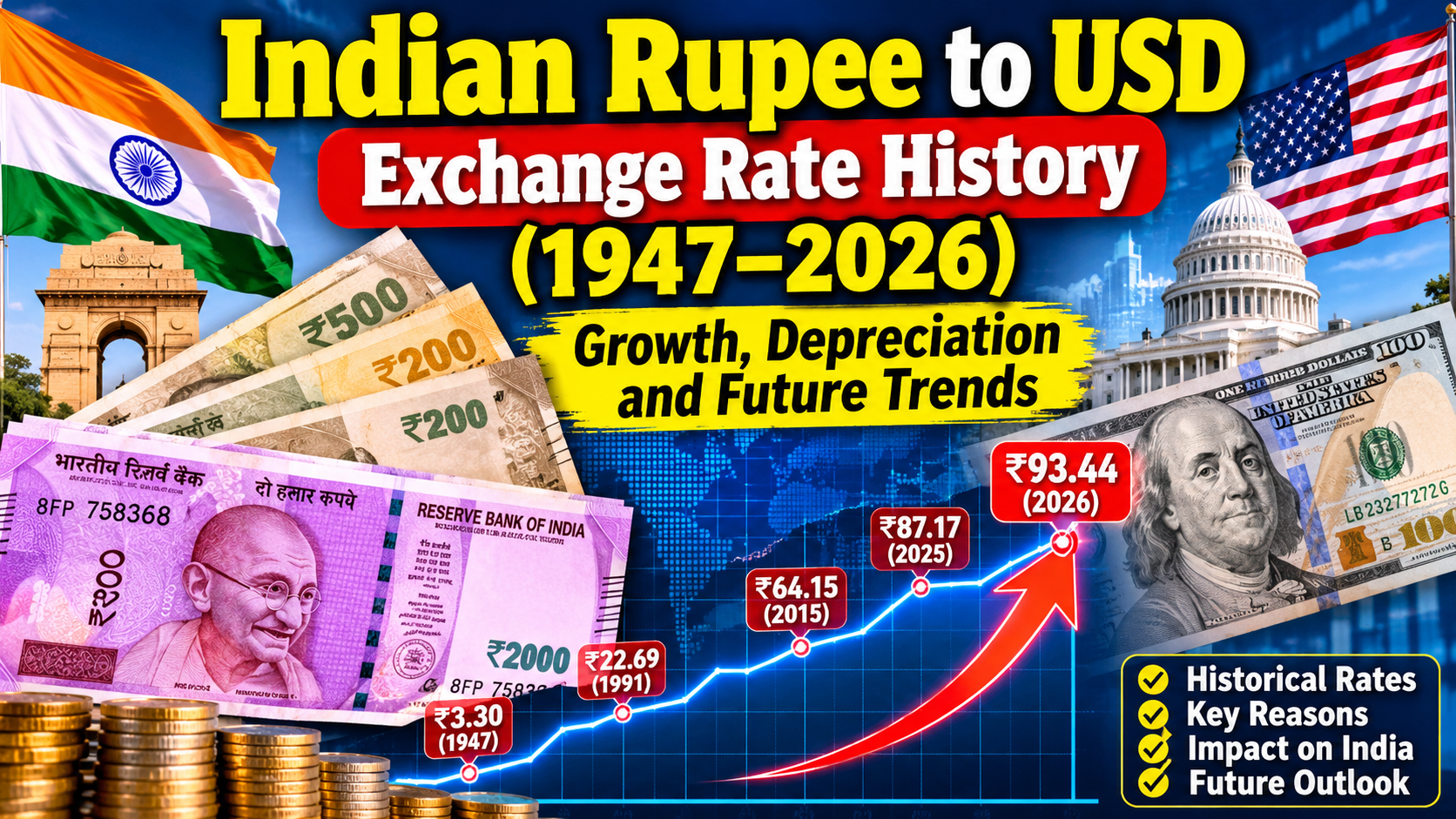
The Indian Rupee (INR) and the United States Dollar (USD) have experienced significant changes over the decades. Since India’s independence in 1947, the value of the Indian currency against the US Dollar has changed dramatically. In the early years, one US Dollar was worth approximately ₹3.30. Today, the exchange rate is above ₹90 per dollar.
This long-term change is an important part of India’s economic history. It reflects inflation, international trade, economic development, foreign investment, oil prices, global financial crises and changes in monetary policy.
Many people search for the Indian Rupee to USD rate increase history because they want to understand why the dollar has become more expensive compared with the rupee.
One important point is that when the USD/INR exchange rate increases, it generally means the Indian Rupee has depreciated against the US Dollar. For example, when the exchange rate moves from ₹50 to ₹90 for one dollar, more Indian Rupees are required to purchase the same dollar.
Let’s explore the complete history and important milestones from 1947 to 2026.
Indian Rupee to USD Exchange Rate History (1947–2026)
The following table provides selected historical exchange-rate milestones. Figures are approximate historical reference values and annual averages where indicated.
| Year | 1 US Dollar in Indian Rupees |
|---|---|
| 1947–48 | ₹3.32 |
| 1950–51 | ₹4.78 |
| 1960–61 | ₹4.76 |
| 1966–67 | ₹7.50 |
| 1970–71 | ₹7.56 |
| 1980 | Around ₹7.86 |
| 1990 | ₹17.50 |
| 1991 | ₹22.69 |
| 1995 | ₹32.42 |
| 2000 | ₹44.94 |
| 2005 | ₹44.10 |
| 2010 | ₹45.73 |
| 2015 | ₹64.15 |
| 2018 | ₹68.39 |
| 2020 | ₹74.10 |
| 2021 | ₹73.92 |
| 2022 | ₹78.60 |
| 2023 | ₹82.60 |
| 2024 | ₹83.67 |
| 2025 | ₹87.17 |
| 2026 | Above ₹90 during the year |
Source: Reserve Bank of India annual exchange-rate statistics. Figures use different historical reporting periods in the earliest years.
1. Indian Rupee History Between 1947 and 1960
After independence in 1947, India’s economy was developing and the country was building its financial institutions. During this period, one US Dollar was approximately equal to ₹3.30.
The Indian Rupee’s exchange value was influenced by the international monetary system and its historical relationship with the British Pound.
During the 1950s, the exchange rate was approximately ₹4.76 per US Dollar. The currency remained relatively stable for several years.
However, India faced several economic challenges, including:
-
Limited industrial development.
-
Dependence on imported machinery.
-
Agricultural development requirements.
-
Foreign exchange shortages.
-
Infrastructure investment requirements.
These factors influenced India’s economic and currency policies.
2. Major Rupee Devaluation in 1966
One of the most important events in Indian currency history occurred in June 1966.
The Indian government devalued the Rupee, changing its value from approximately ₹4.76 to ₹7.50 per US Dollar.
This decision was connected to economic pressures, including foreign exchange shortages, inflation and balance-of-payments difficulties.
The devaluation was intended to improve export competitiveness and support India’s international financial position.
It became a major turning point in the history of the Indian Rupee.
3. USD to INR Exchange Rate Between 1970 and 1990
During the 1970s and 1980s, the Indian economy experienced several important developments.
The exchange rate gradually changed as India faced rising import costs, inflation and international economic pressures.
By 1980, the exchange rate was around ₹7.86 per dollar.
By 1990, the annual average had reached approximately ₹17.50 per dollar.
Some important factors included:
-
Rising international oil prices.
-
Increasing demand for imported products.
-
Government expenditure.
-
Inflation.
-
Foreign currency requirements.
During the late 1980s, the Indian Rupee was allowed to depreciate gradually against major international currencies.
4. The 1991 Economic Crisis and Rupee Depreciation
The year 1991 was one of the most important periods in India’s economic history.
India faced a serious balance-of-payments crisis. Foreign exchange reserves were extremely low, making it difficult for the country to pay for essential imports.
The government introduced major economic reforms and devalued the Rupee in two stages in July 1991.
The exchange rate moved significantly, and the annual average reached approximately ₹22.69 per US Dollar.
The reforms introduced important changes in India’s economy, including:
-
Liberalisation of the economy.
-
Greater opportunities for foreign investment.
-
Changes in import and export policies.
-
Industrial deregulation.
-
Expansion of international trade.
These reforms helped transform India’s economy and its relationship with global markets.
5. Indian Rupee vs US Dollar Between 2000 and 2010
The 2000s were an important decade for India’s economic growth.
India experienced expansion in information technology, telecommunications, banking, manufacturing and international business.
However, the Rupee continued to fluctuate against the US Dollar.
According to RBI annual average statistics:
-
2000: ₹44.94 per dollar.
-
2005: ₹44.10 per dollar.
-
2007: ₹41.35 per dollar.
-
2008: ₹43.50 per dollar.
-
2009: ₹48.40 per dollar.
-
2010: ₹45.73 per dollar.
The global financial crisis of 2008 affected international financial markets. Foreign investment movements and global economic uncertainty influenced the Indian currency.
Interestingly, the Rupee strengthened during some years of this decade before experiencing renewed depreciation.
6. Rupee Depreciation Between 2011 and 2020
Between 2011 and 2020, the Indian Rupee experienced several major fluctuations.
In 2013, the Rupee came under significant pressure because of concerns about the US Federal Reserve reducing its monetary stimulus. This period became widely known as the taper tantrum.
The exchange rate moved from approximately ₹46.67 in 2011 to ₹58.60 in 2013, based on annual average figures.
Other important developments included:
-
Rising crude oil import expenses.
-
Changes in foreign investment.
-
International economic uncertainty.
-
US Dollar strength.
-
Inflation and trade imbalances.
By 2015, the annual average exchange rate was approximately ₹64.15 per dollar.
In 2020, the COVID-19 pandemic created significant uncertainty across global markets. The annual average exchange rate reached approximately ₹74.10 per dollar.
7. Indian Rupee History Between 2021 and 2026
The 2021–2026 period has brought further changes to the USD/INR exchange rate.
The global economy experienced inflation, higher interest rates, geopolitical uncertainty and changing international investment patterns.
Here are some important annual average figures:
| Year | USD to INR |
|---|---|
| 2021 | ₹73.92 |
| 2022 | ₹78.60 |
| 2023 | ₹82.60 |
| 2024 | ₹83.67 |
| 2025 | ₹87.17 |
In 2022, the US Dollar strengthened significantly as the Federal Reserve increased interest rates to control inflation.
In 2023 and 2024, the Rupee remained relatively stable compared with some earlier periods of sharp depreciation.
In 2025, the annual average reached approximately ₹87.17 per dollar.
In 2026, the exchange rate continued to experience fluctuations. On November 18, 2026, Reuters reported that the Rupee closed at approximately ₹93.44 per US Dollar.
Reuters
These figures show that currency markets can move in both directions. The Rupee does not necessarily lose value every day or every year.
8. Why Does the US Dollar Become More Expensive Against the Indian Rupee?
There are several important reasons behind the long-term movement of the exchange rate.
1. Inflation differences
If inflation in India remains higher than in the United States over an extended period, it can contribute to pressure on the Rupee.
2. Crude oil imports
India imports a significant amount of crude oil. When international oil prices increase, the country may require more foreign currency to pay its import bills.
3. US Federal Reserve interest rates
Higher US interest rates can attract international investors towards dollar-denominated assets. This can increase demand for dollars.
4. Foreign investment
When foreign investors purchase Indian shares and bonds, they may increase demand for Rupees. When they withdraw investments, currency pressure can increase.
5. International trade
India’s import and export balance also influences foreign currency demand. Higher import payments can increase demand for dollars.
6. Global economic uncertainty
Wars, financial crises, geopolitical tensions and international market instability can encourage investors to hold US Dollars as a safe-haven currency.
9. How Does Rupee Depreciation Affect Ordinary Indians?
Changes in the USD/INR exchange rate affect different sections of the Indian economy.
Negative effects:
-
Imported electronics may become more expensive.
-
Petrol and diesel costs can face additional pressure.
-
Overseas education expenses may increase.
-
Foreign holidays become more expensive.
-
Businesses importing machinery may face higher costs.
Potential positive effects:
-
Indian exporters may receive more Rupees for dollar-denominated earnings.
-
IT companies earning revenue in US Dollars may benefit.
-
Some international service providers can become more competitive.
The actual impact depends on business costs, global demand, inflation and other economic conditions.
10. Will the Indian Rupee Become Stronger Against the US Dollar?
The future of the Indian Rupee depends on several economic factors.
India has significant opportunities for economic growth through manufacturing, technology, infrastructure, exports and international investment.
Some factors that could support the Rupee include:
-
Increasing foreign direct investment.
-
Stronger exports.
-
Lower domestic inflation.
-
Stable crude oil prices.
-
Higher foreign exchange reserves.
-
Strong economic growth.
However, international economic conditions can also create challenges.
It is important to understand that a weaker Rupee does not automatically mean the Indian economy is performing poorly. Currency exchange rates depend on several domestic and international factors.
There is also no guarantee that the Rupee will reach a particular value against the Dollar in the future.
11. Where Can You Check the Latest USD to INR Exchange Rate?
People can check the latest exchange rates through several financial platforms.
Some useful sources include:
Remember that bank exchange rates, card conversion rates and money-transfer rates may differ from published reference rates because of fees and margins.
Conclusion
The history of the Indian Rupee against the US Dollar demonstrates how India’s economy has changed since independence.
In 1947, one US Dollar was approximately ₹3.30. By 1991, it was around ₹22.69 on an annual average basis. By 2025, the annual average had reached approximately ₹87.17.
In November 2026, the exchange rate was trading around ₹93–94 per dollar.
The long-term movement reflects India’s economic development, international trade, inflation, crude oil imports, foreign investment and global financial conditions.
Understanding the USD to INR exchange rate history is useful for students, business owners, investors, travellers, exporters and anyone who makes international payments.
As India continues developing its economy, the Rupee’s future movement against the US Dollar will remain an important subject for financial markets and ordinary citizens.