
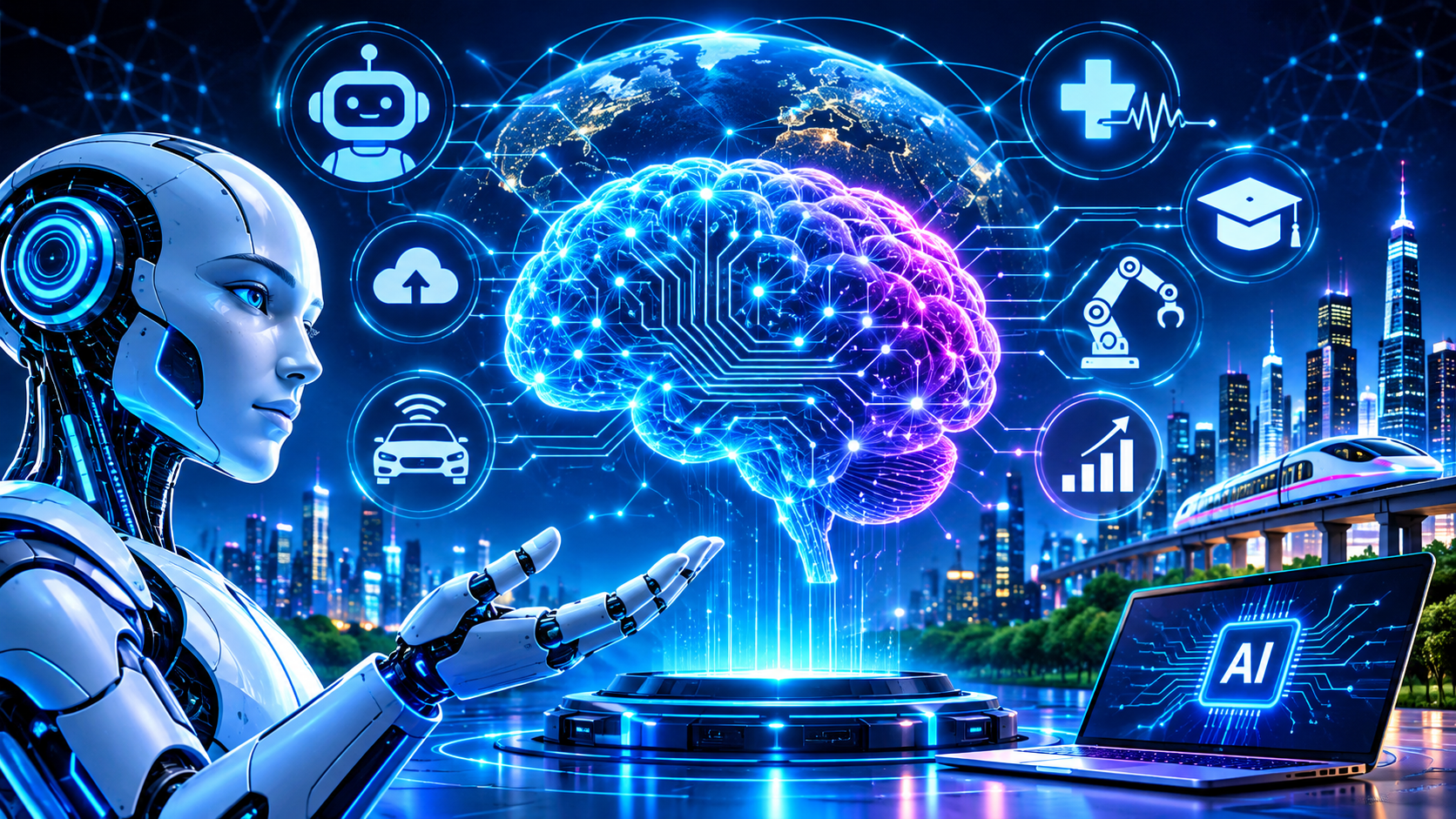
What Is Artificial Intelligence in 2026?
Contents
Artificial intelligence is a technology that allows computer systems to perform tasks that normally require human intelligence. These tasks include understanding language, analyzing data, generating images, answering questions, recognizing patterns, writing content and making predictions.
In 2026, AI technology is becoming more advanced than traditional chatbots. Many systems can now work with text, images, audio, documents and other types of information. AI-powered assistants are also increasingly designed to help users complete tasks instead of simply answering questions.
AI technology is being used in education, banking, healthcare research, business, transportation, entertainment, customer support and online marketing.
Companies are investing heavily in AI research and development to create faster, more efficient and more useful tools for everyday users.
1. AI Agents Are Becoming More Advanced
One of the biggest artificial intelligence trends in 2026 is the development of AI agents. AI agents are designed to perform multi-step tasks, helping users manage workflows, organize information, research topics and complete digital activities.
Unlike traditional AI chatbots that mainly respond to questions, AI agents can sometimes use connected tools, interact with software and work through several steps to complete a task.
Businesses are exploring AI agents for:
-
Customer support and automated responses.
-
Research and data analysis.
-
Scheduling and workflow management.
-
Business operations and reporting.
-
Software development and testing.
AI agents are becoming an important part of the next generation of digital services.
2. New AI Tools and Chatbots in 2026
AI tools are becoming more useful for students, professionals, bloggers, business owners and content creators. Users can use AI assistants to prepare reports, draft emails, brainstorm ideas, organize projects and learn new skills.
The latest AI development trend is not only about producing text. AI platforms increasingly support multiple formats, including images, audio, files and interactive experiences.
The competition between AI companies is also encouraging improvements in performance, accessibility, productivity and user experience.
3. AI Technology Is Changing Business
Artificial intelligence is creating new opportunities for businesses in 2026. Small businesses and large organizations are using AI-powered tools to improve productivity, reduce repetitive work and analyze business information.
AI is being used in online shopping, marketing, customer service, financial analysis, inventory management and business planning.
For example, an online business may use AI to help write product descriptions, respond to common customer questions, create promotional content and analyze sales data.
Companies are also exploring AI automation to make business processes faster and more efficient. However, organizations must carefully manage privacy, accuracy and security when using AI systems.
4. AI in Smartphones and Everyday Technology
Smartphones are becoming more AI-powered in 2026. Mobile manufacturers are integrating artificial intelligence into camera features, voice assistants, translation, photo editing, battery optimization and personal productivity.
AI-powered smartphones may help users:
-
Remove unwanted objects from photographs.
-
Translate languages in real time where supported.
-
Summarize messages and documents.
-
Improve photography and video quality.
-
Organize personal information.
-
Use voice commands for supported tasks.
Smartphone AI is becoming an important feature for new mobile devices. Manufacturers are competing to provide more intelligent and convenient features through software and hardware improvements.
5. Artificial Intelligence in Education
Artificial intelligence is also changing the education sector. Students can use AI tools to understand difficult subjects, practice language skills, summarize lessons and prepare study materials.
Teachers and educational institutions are exploring AI to support personalized learning, administrative tasks and educational content development.
AI can help students learn at their own pace by providing explanations and practice exercises. However, students should not depend entirely on AI for their education.
Fact-checking, critical thinking, creativity and original learning remain important skills. AI should be used as a learning assistant rather than a replacement for understanding and studying.
6. AI in Healthcare and Medical Research
Healthcare is another important area where AI technology is being developed. Researchers and medical organizations are exploring artificial intelligence for medical imaging analysis, scientific research, administrative workflows, patient information management and drug discovery.
AI tools may help healthcare professionals organize information and support research activities. Some AI systems are designed to assist in detecting patterns in medical data, but their effectiveness depends on the technology, data quality and clinical validation.
AI is not a replacement for qualified doctors. Medical decisions should continue to involve trained healthcare professionals.
7. AI and Search Engines Are Changing
Search engines are increasingly integrating artificial intelligence into search results. AI-powered search experiences are designed to provide summaries, explanations and relevant information alongside traditional links.
In 2026, AI is becoming an important part of online search, digital marketing and content discovery. Search platforms are experimenting with AI-generated answers, new source links and additional ways for users to interact with search results.
Recent AI and SEO industry reports have also highlighted developments involving AI search features, publisher controls and changes in how websites appear in AI-powered search experiences.
Website owners and bloggers may need to focus more on original content, reliable information, clear writing, useful articles and strong website experiences.
8. AI Content Creation and Digital Marketing
AI content creation is growing rapidly in 2026. Bloggers, YouTubers, marketers and social media creators are using AI tools to help develop ideas, prepare scripts, create images, draft articles and plan marketing campaigns.
AI tools can help creators save time, but high-quality content still requires human creativity, research and editing.
Some common AI content applications include:
-
Blog article drafting.
-
Social media content planning.
-
AI image generation.
-
Video script writing.
-
Marketing campaign ideas.
-
SEO content research.
-
Product descriptions.
The most effective content strategy combines AI assistance with real knowledge, accurate information and original ideas.
9. The Future of Artificial Intelligence
The future of artificial intelligence is expected to include more intelligent assistants, advanced automation, AI-powered devices, smarter software and improved communication between humans and machines.
AI technology may become more integrated into homes, offices, smartphones, cars, education and online services.
However, the development of AI also brings important challenges. Privacy, cybersecurity, misinformation, job changes, copyright, responsible AI use and the reliability of AI-generated information will remain major issues.
Governments, technology companies, researchers and businesses will need to work together to develop responsible AI systems.
Conclusion
Artificial Intelligence Latest Updates 2026 show how rapidly AI technology is changing the digital world. AI agents, smart chatbots, AI smartphones, business automation, education tools, healthcare research and AI-powered search are becoming important parts of modern technology.
Artificial intelligence is creating new opportunities for individuals and businesses, but users should understand its limitations and use it responsibly. The future of AI will depend not only on technological innovation but also on safety, trust, transparency and human creativity.
AI is no longer just an emerging technology. It is becoming a major part of everyday digital life in 2026.