
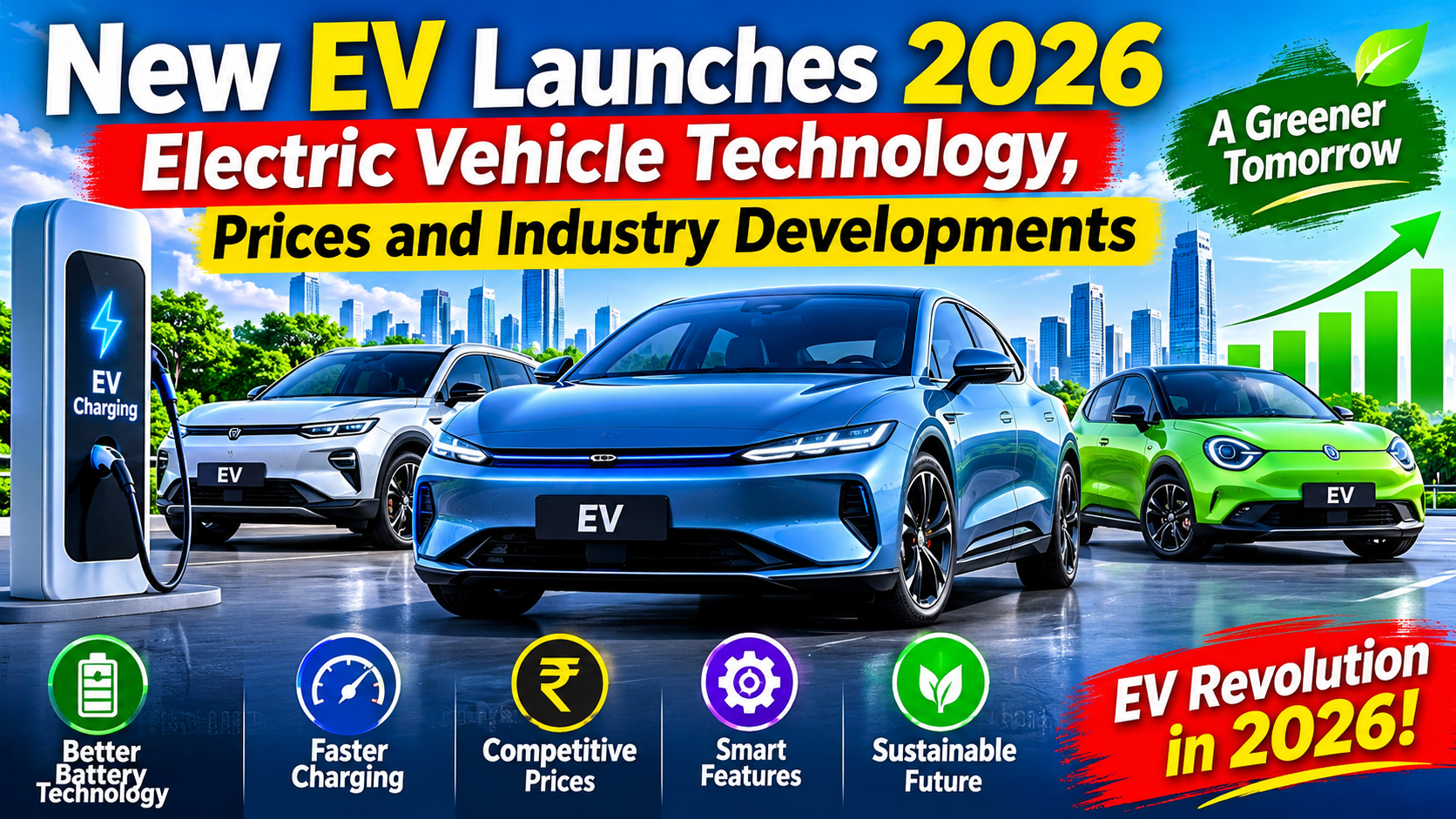
New EV Launches, Electric Vehicle Technology, Prices and Industry Developments in 2026
Contents
Electric vehicle (EV) technology is transforming the global automotive industry in 2026. From new electric car launches and improved battery technology to smart charging systems and affordable EV models, the electric mobility market continues to develop rapidly. Automakers are investing in innovation, performance, sustainability and digital features to attract customers and prepare for the future of transportation.
As electric vehicles become more popular, buyers are increasingly interested in battery range, charging speed, vehicle prices, safety features and long-term ownership costs. New developments are making EVs an important part of the future automotive market.
Latest Electric Vehicle Launches and Market Developments
The EV market is seeing new launches across multiple categories, including luxury SUVs, electric hatchbacks, family vehicles and commercial electric vehicles. Automakers are focusing on delivering better performance, modern design and improved driving range while expanding their electric vehicle portfolios.
In India, the electric vehicle industry is also gaining attention as both domestic and international companies introduce new models and technologies. Recent developments show that the market is moving beyond early electric car adoption toward a wider range of vehicles for different customer needs.
Mercedes-Benz GLC Electric
The Mercedes-Benz GLC Electric has become one of the notable premium EV launches in India in November 2026. The model features a large battery pack, dual-motor configuration and advanced digital technologies.
The reported starting price in India is ₹78.50 lakh ex-showroom. The vehicle is designed for customers looking for luxury, modern infotainment, advanced driver-assistance features and electric driving performance. Its launch reflects the continued expansion of premium electric vehicles in the Indian automotive market.
MINI Cooper SE
The new-generation MINI Cooper SE is another electric vehicle attracting attention in November 2026. The model features a 54.2kWh battery, modern exterior styling and an updated electric powertrain.
Global specifications include a claimed WLTP range of approximately 402 kilometres, although range and specifications may differ in the Indian version. The MINI Cooper SE represents the growing demand for compact electric cars that combine city-friendly dimensions with modern electric technology.
Upcoming Electric Vehicle Developments
Automakers are also preparing future electric vehicles with new platforms, advanced software and improved battery systems. Several upcoming EV projects are focused on making electric mobility more accessible, particularly in the compact SUV and small-car segments.
New electric vehicle launches are expected to bring greater competition in the market, potentially encouraging manufacturers to improve features, pricing strategies and charging compatibility.
Electric Vehicle Technology: What’s Changing in 2026?
Electric vehicle technology is evolving in several important areas. Battery development, charging infrastructure, vehicle software and energy management systems are playing a major role in the next generation of electric cars.
1. Battery Technology Improvements
The battery is one of the most important components of an electric vehicle. Manufacturers and battery companies are working to improve energy density, charging performance, durability and manufacturing costs.
Modern battery systems are designed to provide improved energy management, better thermal control and more efficient power delivery. New battery chemistries and cell designs could help manufacturers develop EVs with improved range and lower production costs over time.
2. Faster EV Charging
Charging technology is becoming faster and more efficient. High-power charging systems are helping reduce charging time for compatible vehicles, while new charging networks are expanding in cities, highways and commercial locations.
According to the International Energy Agency, developments in battery cells, power electronics and higher-voltage vehicle architectures are supporting faster charging. Smart charging systems can also help manage electricity demand.
3. Artificial Intelligence and Smart Features
Artificial intelligence is increasingly being integrated into electric vehicles. Modern EVs may include intelligent voice assistants, navigation systems, connected infotainment, software updates and advanced driver-assistance technologies.
AI-powered vehicle systems can help improve the user experience by providing more responsive digital services and supporting certain driving-assistance functions. Automakers are also developing software-defined vehicles, where important vehicle functions can be improved through software updates.
4. Smart Battery Management Systems
Battery management systems are responsible for monitoring battery conditions, temperature, charging status and energy usage. Improved battery management technology can help manufacturers maintain battery performance and monitor operating conditions.
These systems are becoming increasingly important as electric vehicles use larger batteries, faster charging technologies and more advanced electronic components.
Electric Vehicle Prices and Affordability
Electric vehicle prices remain one of the major factors influencing customer decisions. Premium EVs offer advanced features and larger batteries, but affordable electric cars are also becoming an important part of the industry.
The overall cost of an EV depends on several factors, including battery capacity, vehicle size, brand, technology, features and local taxes. Some manufacturers are also exploring battery rental or battery-as-a-service arrangements to reduce the initial vehicle purchase cost.
In India, electric vehicle buyers may also benefit from applicable government incentives, depending on the vehicle, location and current policies. However, customers should check the latest official pricing, eligibility conditions and charging availability before purchasing an EV.
The development of more affordable electric vehicles could help expand the market among first-time buyers, families and urban commuters.
EV Industry Developments Around the World
The electric vehicle industry is experiencing major changes in manufacturing, competition and technology. Companies are investing in battery production, vehicle assembly, software development, charging networks and research.
Growing Competition Among Automakers
Traditional automobile manufacturers and EV-focused companies are competing to develop new electric models. Competition is increasing across luxury vehicles, compact cars, SUVs and commercial transportation.
Manufacturers are attempting to differentiate their products through battery range, digital features, charging performance, design and customer service. Competition could encourage more innovation and a wider selection of vehicles for consumers.
Expansion of EV Charging Infrastructure
Charging infrastructure is another important part of the electric vehicle industry. Public charging stations, home charging equipment and highway charging networks are being developed to support EV adoption.
Reliable charging infrastructure can make electric vehicles more practical for daily commuting and longer journeys. Smart charging and energy management systems may also help balance electricity demand as the number of EVs increases.
Electric Vehicles and Sustainability
Electric vehicles are often considered an important technology for reducing transport-related emissions. Their overall environmental impact, however, also depends on electricity generation, battery manufacturing, materials sourcing and recycling.
The industry is increasingly focusing on battery recycling, responsible sourcing of materials, energy-efficient manufacturing and improved vehicle lifecycle management.
What Can EV Buyers Expect in the Future?
The future of electric vehicles may include more affordable models, improved battery performance, faster charging, better software and expanded charging infrastructure. Automakers are also exploring new vehicle designs and technologies that could make EVs more practical for a broader range of customers.
For buyers, the most important factors will remain affordability, real-world driving range, charging access, warranty coverage, safety and reliability.
The next few years could bring significant changes to the automotive industry as manufacturers continue developing new electric vehicle platforms and technologies.
Conclusion
New electric vehicle launches, battery technology improvements, charging innovations and digital features are shaping the automotive industry in 2026. Electric vehicles are expanding across different price ranges and vehicle categories, while manufacturers are investing in better technology and charging infrastructure.
From luxury electric SUVs to compact electric hatchbacks, the EV market is becoming more competitive. Although challenges such as charging access, affordability and battery production remain, ongoing innovation could make electric mobility more accessible in the coming years.