
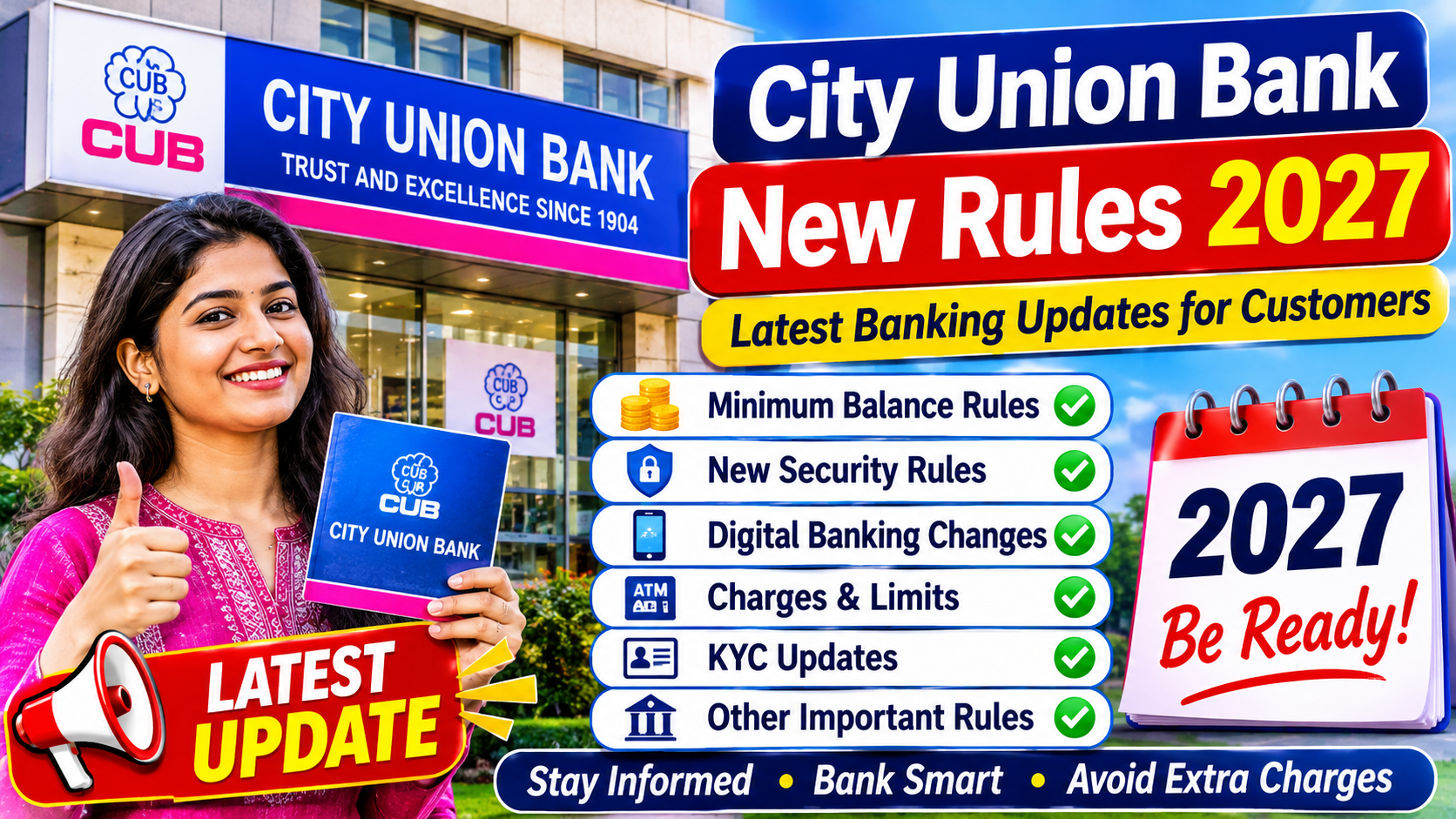
City Union Bank New Rules 2027 – Complete Overview
Contents
City Union Bank is an established private-sector bank in India that provides savings accounts, current accounts, fixed deposits, loans, debit cards and digital banking services. As banking services continue to become more technology-driven, customers need to stay informed about changes in account maintenance, transaction charges, security requirements and online banking facilities.
The City Union Bank New Rules 2027 are an important topic for account holders who want to manage their money safely and avoid unnecessary banking charges. Customers should understand that a new calendar year does not automatically mean every banking rule will change. Official bank notifications and Reserve Bank of India (RBI) directions determine which changes actually apply.
One significant development is the new RBI framework for unauthorised electronic banking transactions, which applies to relevant transactions from January 1, 2027. City Union Bank customers should also pay attention to the bank’s new internet and mobile banking platform, which is scheduled to replace its existing platform from October 30, 2026.
1. City Union Bank Minimum Balance Rules 2027
Minimum balance is one of the most important things savings account customers should understand. Banks may require customers to maintain a specified average balance depending on the account type and banking facilities.
According to City Union Bank’s published service-charge schedule, effective April 1, 2026, savings accounts with a debit card have a minimum monthly average balance requirement of Rs. 7,500.
The published maintenance charges for accounts below this threshold are:
| Monthly average balance | Monthly charge |
|---|---|
| Up to Rs. 4,000 | Rs. 100 |
| Above Rs. 4,000 up to Rs. 6,000 | Rs. 75 |
| Above Rs. 6,000 up to Rs. 7,500 | Rs. 50 |
| Above Rs. 7,500 | No charge |
Customers without debit cards have different balance requirements depending on whether their branch is located in a metropolitan, urban or semi-urban area and whether they have a cheque-book facility.
These figures are the bank’s published 2026 charges, not a separately confirmed new 2027 tariff. Customers should check the latest official schedule before making financial decisions.
2. New RBI Digital Banking Security Rules From January 1, 2027
One of the most important confirmed changes for 2027 concerns protection against fraudulent electronic banking transactions.
The Reserve Bank of India issued revised directions on June 24, 2026, which apply to electronic banking transactions undertaken from January 1, 2027.
These directions cover customers of commercial banks, including private-sector banks such as City Union Bank.
Important provisions include:
-
Banks must provide suitable channels for reporting fraudulent transactions 24 hours a day, seven days a week.
-
Banks must send instant SMS alerts for electronic banking transactions above Rs. 500.
-
Email alerts must be sent for electronic transactions wherever the customer has provided an email address.
-
Banks must provide a complaint acknowledgement with a reference number.
-
Banks must take prompt action to prevent further unauthorised transactions after receiving a fraud complaint.
-
Eligible customers may receive zero-liability protection in specified circumstances.
The RBI also requires banks to examine fraud complaints within a maximum of 45 calendar days for domestic transactions and 60 calendar days for cross-border transactions.
Compensation for Eligible Digital Banking Fraud
The new RBI directions also introduce a compensation mechanism for certain small-value fraudulent electronic transactions.
Eligible individual customers, including sole proprietors, may receive compensation of 85% of their net loss or Rs. 25,000, whichever is lower.
However, this benefit is subject to important conditions:
-
The total gross loss must not exceed Rs. 50,000.
-
The customer must report the fraud to the bank and the National Cyber Crime Reporting Portal or helpline 1930 within five calendar days.
-
The loss must be established as genuine under the bank’s procedures.
-
The compensation can be claimed only once during the customer’s lifetime.
Customers should understand that this is not automatic compensation for every online scam. Eligibility depends on the circumstances and RBI conditions.
3. City Union Bank New Mobile Banking and Internet Banking Rules
City Union Bank has already introduced a new digital banking platform called CUB New All in One.
According to the bank’s official website, its existing internet banking and mobile banking services are scheduled to be discontinued from October 30, 2026.
Customers are encouraged to register for the new platform rather than waiting until they need to make an urgent payment.
The new digital banking platform offers several useful facilities:
-
Faster fund transfers from the banking dashboard.
-
Online nominee addition, modification and deletion.
-
QR-code-based access to internet banking.
-
Better account information and personalised dashboards.
-
Scheduled payment and loan instalment reminders.
-
Multiple beneficiary fund transfers.
-
Control over digital transaction limits.
-
Online complaint registration and tracking.
-
Digital service requests without visiting a branch.
The bank also states that existing beneficiaries, scheduled payments and transaction-limit details will be migrated during registration or the first login to the new application.
Customers should use the official bank website or verified app-store listing to register.
4. City Union Bank KYC Rules 2027
Know Your Customer (KYC) is an essential banking requirement. It helps banks verify customer identities and prevent fraudulent activities, money laundering and unauthorised account usage.
City Union Bank customers should ensure that their identity and contact details remain updated.
Important KYC details include:
-
PAN information, wherever applicable.
-
Aadhaar or other officially valid identity documents, as applicable.
-
Current residential address.
-
Registered mobile number.
-
Registered email address.
-
Updated customer identification information.
Customers who have changed their mobile number, address or email address should update their records with the bank.
KYC requirements may vary depending on the account category, customer risk classification and applicable RBI instructions. Therefore, customers should not assume that every account holder needs to submit documents again in 2027.
If the bank sends a genuine re-KYC request, customers should follow the instructions through official banking channels. Never share an OTP, PIN or password with someone claiming to complete KYC over the phone.
5. ATM and Debit Card Transaction Rules
ATM and debit card facilities remain important for City Union Bank customers who regularly withdraw cash, check balances and make payments.
According to the bank’s published service-charge schedule, savings account holders using other banks’ ATMs generally receive up to five free transactions per month under the applicable conditions.
After the free limit, the published charges include:
| Transaction type | Published charge |
|---|---|
| Financial transaction | Rs. 23 + GST |
| Non-financial transaction | Rs. 8.50 + GST |
Certain account categories and balance conditions have exemptions.
The bank also lists a quarterly debit card charge of Rs. 100 where the applicable quarterly average balance is below Rs. 15,000.
These are published charges effective from April 1, 2026, and should not be mistaken for newly announced 2027 rates. Customers should verify the latest schedule before using banking services.
6. City Union Bank NEFT, RTGS and IMPS Rules
Digital money transfers are widely used by customers for shopping, education fees, business payments and personal transactions.
City Union Bank provides NEFT, RTGS and IMPS facilities through its digital and branch banking channels.
According to its published service-charge schedule:
| Transfer method | Published charges |
|---|---|
| Online NEFT | Free |
| Branch NEFT up to Rs. 10,000 | Rs. 1.50 |
| Branch NEFT above Rs. 10,000 up to Rs. 1 lakh | Rs. 4 |
| Branch NEFT above Rs. 1 lakh up to Rs. 5 lakh | Rs. 14 |
| Online RTGS | Free |
| Branch RTGS Rs. 2 lakh to Rs. 5 lakh | Rs. 24 |
| Branch RTGS above Rs. 5 lakh | Rs. 49 |
Online IMPS charges listed by the bank are:
-
Up to Rs. 1,000: Rs. 2.50.
-
Above Rs. 1,000 up to Rs. 25,000: Rs. 5.
-
Above Rs. 25,000 up to Rs. 5 lakh: Rs. 15.
These charges are based on the published tariff and may be revised by the bank. Customers should check the applicable charges before initiating transactions.
7. Basic Savings Bank Deposit Account Rules
Customers who want to avoid minimum balance requirements can explore the Basic Savings Bank Deposit (BSBD) account.
City Union Bank’s published BSBD facilities include:
-
No minimum balance requirement.
-
No initial deposit requirement.
-
Free cash deposits.
-
Free electronic receipt of money.
-
No limit on the number and value of monthly deposits.
-
Free ATM or debit card annual charges.
-
Free cheque book with 25 leaves per year.
-
Internet and mobile banking facilities.
-
Free passbook and account statements.
-
Four withdrawals per month, including transfers and ATM transactions.
The bank also states that existing eligible savings accounts can be converted into BSBD accounts following a customer request, subject to the applicable conditions.
This can be a useful option for customers who want basic banking services without maintaining a conventional minimum balance.
8. Important Rules for Current Account Holders
City Union Bank also provides current accounts for business owners, traders, professionals and companies.
Different current account categories have different monthly average balance requirements.
The published schedule includes:
| Current account category | Minimum monthly average balance |
|---|---|
| Start-Up | Nil |
| Regular | Rs. 10,000 |
| Silver | Rs. 25,000 |
| Gold / General | Rs. 50,000 |
| Classic Plus / Platinum | Rs. 1,00,000 |
Business customers should review their account category before making financial plans for 2027.
They should also check cash deposit limits, non-home branch transaction charges, cheque return charges and other applicable service fees.
Maintaining the required balance and keeping business documentation updated can help avoid unnecessary banking problems.
9. Important Safety Rules for City Union Bank Customers
Digital banking makes financial transactions easier, but customers must remain careful about online fraud.
Here are some important precautions:
-
Never share your ATM PIN, OTP or internet banking password.
-
Do not install unknown applications sent through WhatsApp or SMS.
-
Avoid clicking suspicious banking links.
-
Use only the official CUB mobile application.
-
Check your account balance and transaction history regularly.
-
Keep your registered mobile number active.
-
Report unauthorised transactions immediately.
-
Never approve a payment request without checking the amount and beneficiary.
-
Contact the bank using its verified customer-care details.
If you experience digital payment fraud, contact your bank immediately and report the incident through India’s cybercrime helpline 1930 or the official cybercrime reporting portal.
Quick reporting can make an important difference in preventing further losses.
10. What Should Customers Do Before January 2027?
City Union Bank customers can take a few simple steps to prepare for the upcoming year.
-
Check your monthly average account balance.
-
Review the latest bank service charges.
-
Complete any pending KYC requirements.
-
Register for the new CUB digital banking platform.
-
Update your mobile number and email address.
-
Check your debit card and ATM transaction limits.
-
Review your beneficiaries and scheduled payments.
-
Learn how to report fraudulent transactions.
-
Keep your account statements and important banking records.
These steps can help customers avoid unnecessary difficulties and use their accounts more efficiently.
Frequently Asked Questions (FAQs)
1. What are the new City Union Bank rules for 2027?
The confirmed major regulatory change is the revised RBI framework for unauthorised electronic banking transactions, applicable from January 1, 2027. Customers should also follow the bank’s latest account and service-charge notifications.
2. What is the minimum balance in City Union Bank savings accounts?
The published requirement for savings accounts with debit cards is Rs. 7,500 monthly average balance. Requirements for accounts without debit cards vary according to branch location and cheque-book facilities.
3. Will City Union Bank change its ATM charges in 2027?
No separate general 2027 ATM tariff has been established by the information cited in this article. Customers should check the bank’s latest official service-charge schedule.
4. Is City Union Bank introducing a new mobile banking application?
Yes. The bank has introduced CUB New All in One, its new digital banking platform.
5. When will the old City Union Bank mobile banking service stop?
The bank’s published notice states that existing internet and mobile banking services are scheduled to be discontinued from October 30, 2026.
6. Can customers maintain a zero-balance account?
Eligible customers can consider the bank’s Basic Savings Bank Deposit account, which has no minimum balance requirement.
7. What happens if someone loses money through online banking fraud?
Customers should immediately report the transaction to the bank and the cybercrime helpline 1930. From January 1, 2027, the revised RBI framework provides specified customer protections and compensation provisions subject to eligibility.
Conclusion
The City Union Bank New Rules 2027 are important for savings account holders, current account customers, debit card users and people who regularly use online banking.
The most significant confirmed development is the RBI’s revised digital transaction protection framework starting January 1, 2027. Customers should also complete their transition to the new CUB digital banking platform and review their minimum balance requirements, KYC information and banking charges.
However, customers should remember that the bank’s published 2026 charges are not automatically new 2027 charges. Any future revision should be confirmed through an official City Union Bank notification.
Staying informed and following official banking instructions will help customers manage their accounts safely and conveniently throughout 2027.