
India Conviction Rate Soars: Latest Crime Statistics, Court Performance and Justice System Updates
Contents
India’s criminal justice system continues to attract attention as new crime statistics highlight the relationship between police investigations, court trials and convictions. The phrase “India conviction rate soars” reflects growing interest in how effectively the country’s justice system handles criminal cases. However, the latest available figures show a more complex picture: conviction rates depend on the type of offence, the state concerned and the number of trials completed.
According to figures from India’s National Crime Records Bureau (NCRB), the overall conviction rate for Indian Penal Code (IPC) crimes in 2023 was 54%, while the chargesheeting rate was 72%. These figures were cited by the Ministry of Law and Justice in a Rajya Sabha reply in December 2025.
Understanding India’s Conviction Rate
The conviction rate is an important indicator of the performance of the criminal justice system. It generally measures the proportion of completed criminal trials that result in convictions. A conviction means that a court has found an accused person guilty according to the applicable law and evidence.
A higher conviction rate may indicate effective investigations, reliable evidence collection, stronger prosecution and efficient court proceedings. However, it does not automatically mean that crime is decreasing or that every reported offence is being resolved successfully.
For example, a conviction rate of 54% means that approximately 54 out of every 100 completed trials resulted in convictions, under the relevant statistical definition. It does not mean that 54 out of every 100 crimes reported during the year resulted in convictions.
This distinction is important because many criminal cases take years to reach a final judgment.
Latest Official Statistics on Convictions
The NCRB publishes detailed information about crime registration, investigations, chargesheets, court trials and convictions. Its annual Crime in India reports help researchers, journalists and policymakers understand the performance of the justice system.
The following figures provide useful context:
- 2023 IPC conviction rate: 54%, as cited by the Ministry of Law and Justice.
- 2023 chargesheeting rate: 72%, according to the same parliamentary reply.
- 2024 conviction rate: 53.3% for completed trials involving the relevant penal-code and criminal-law categories, according to a data tracker compiling NCRB statistics.
- 2024 chargesheeting rate: 72.1%, according to the same tracker.
The 2024 figures are based on a different legal and statistical context because India introduced the Bharatiya Nyaya Sanhita (BNS) in place of the IPC during 2024. Therefore, comparisons across years should be made carefully.
Why Can Conviction Rates Rise?
Several factors can contribute to a higher conviction rate in a particular year or category of crime.
1. Better Police Investigations
A criminal investigation must establish the relevant facts and collect admissible evidence. Investigators may need to examine witnesses, gather documents, preserve forensic material and follow the applicable legal procedures.
When investigations are thorough and evidence is properly documented, prosecutors may be better equipped to present cases before the courts.
2. Forensic Science and Digital Evidence
Technology increasingly plays a role in criminal investigations. Forensic laboratories, digital records, CCTV footage and other legally obtained evidence can help investigators establish facts.
Nevertheless, digital and forensic evidence must be collected, preserved and presented according to the law. Technology alone cannot guarantee a conviction.
3. Stronger Prosecution
Public prosecutors present the case on behalf of the state. Effective preparation, careful examination of evidence and compliance with procedural requirements can help courts assess cases more efficiently.
The rights of accused persons must also be protected throughout the process.
4. Faster Court Proceedings
Delays can affect witnesses, evidence and the ability of victims and accused persons to obtain timely justice. Better case management, adequate judicial staffing and suitable court infrastructure may help reduce unnecessary delays.
However, speed must not come at the cost of a fair trial.
The Continuing Challenge of Pending Cases
Although conviction rates receive considerable attention, the number of cases awaiting trial remains a major challenge for India’s justice system.
Many cases registered by police in one year do not reach trial completion during that same year. Courts also carry forward cases from previous years, making it necessary to examine the overall caseload rather than focusing exclusively on convictions.
According to a compilation of NCRB 2024 figures, approximately 1.84 crore criminal cases were before the courts during the year. The same analysis reported that about 8.6% reached the end of trial during 2024.
These figures demonstrate why conviction rates must be interpreted alongside trial completion and case pendency statistics.
A system may record a relatively high conviction rate among completed trials while still having a substantial number of unresolved cases. Both measurements are important when assessing access to justice.
Differences Between States and Union Territories
India’s criminal justice system operates across states and Union Territories with different populations, policing arrangements, court capacity and crime patterns.
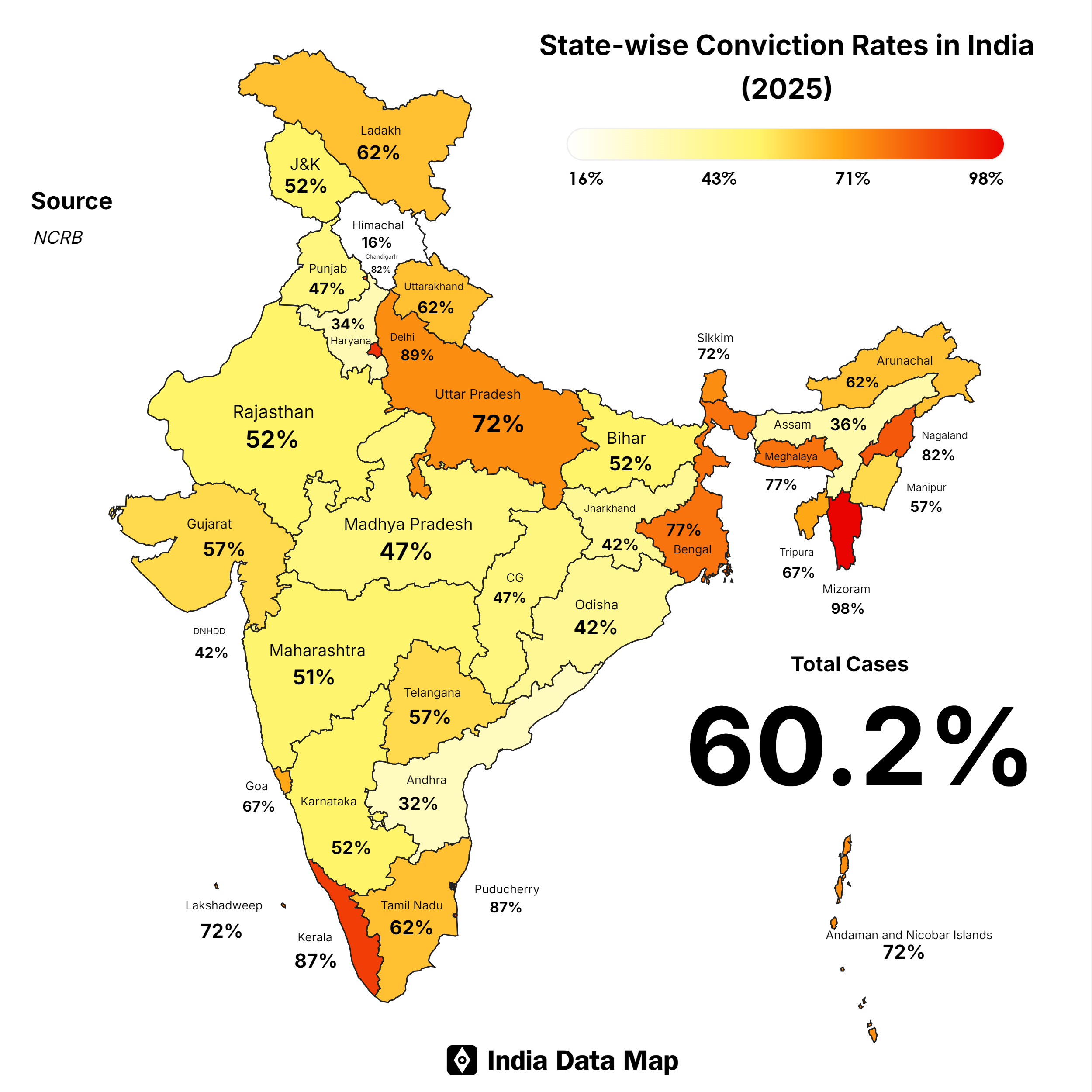
Consequently, conviction rates can vary significantly across jurisdictions. Differences may reflect the types of cases being tried, the quality of investigations, prosecution practices, the speed of proceedings and the volume of older cases being resolved.
A state with a higher conviction rate should not automatically be considered safer than a state with a lower rate. Crime rates, reporting practices, chargesheeting rates, trial completion and the nature of offences must also be considered.
For accurate comparisons, readers should consult the relevant NCRB tables and check that the figures use comparable definitions and reporting periods.
How Criminal Justice Reforms May Help
India has introduced legal and technological measures intended to improve the criminal justice process. The new criminal laws, including the Bharatiya Nyaya Sanhita, the Bharatiya Nagarik Suraksha Sanhita and the Bharatiya Sakshya Adhiniyam, came into effect on 1 July 2024.
These laws address substantive criminal offences, criminal procedure and evidence, respectively.
The government has also pursued digitalisation initiatives through the eCourts project and the Inter-Operable Criminal Justice System. Such measures can support information-sharing, improve access to records and help institutions coordinate their work.
The long-term impact of these reforms should be assessed using reliable data on investigations, trial duration, case disposal, convictions, acquittals and procedural fairness.
What a Higher Conviction Rate Means for Citizens
For citizens, the most important goal is not simply a higher percentage. It is a justice system that investigates offences fairly, protects victims and witnesses, respects the rights of accused persons and delivers decisions without unreasonable delay.
A conviction must be based on evidence and the applicable legal standard. Acquittals are also an essential part of a fair justice system when the prosecution has not established guilt.
Public confidence depends on both accountability and fairness. Improvements in investigation quality, access to legal assistance, judicial infrastructure and transparent reporting can contribute to a stronger justice system.
Conclusion
The discussion surrounding India’s conviction rate highlights both progress and continuing challenges. Official figures cited by the Ministry of Law and Justice put the overall IPC conviction rate at 54% in 2023, while compiled NCRB figures indicate a 53.3% rate for completed trials in the relevant categories in 2024.
These numbers do not, by themselves, establish that India’s conviction rate is soaring. Instead, they underline the need to examine year-on-year changes, differences between states, the number of trials completed and the backlog of pending cases.
The real measure of success will be a criminal justice system that delivers timely, evidence-based and impartial outcomes while safeguarding the legal rights of everyone involved.
Readers should consult the latest NCRB Crime in India report and official government publications for updates as new statistics become available.