
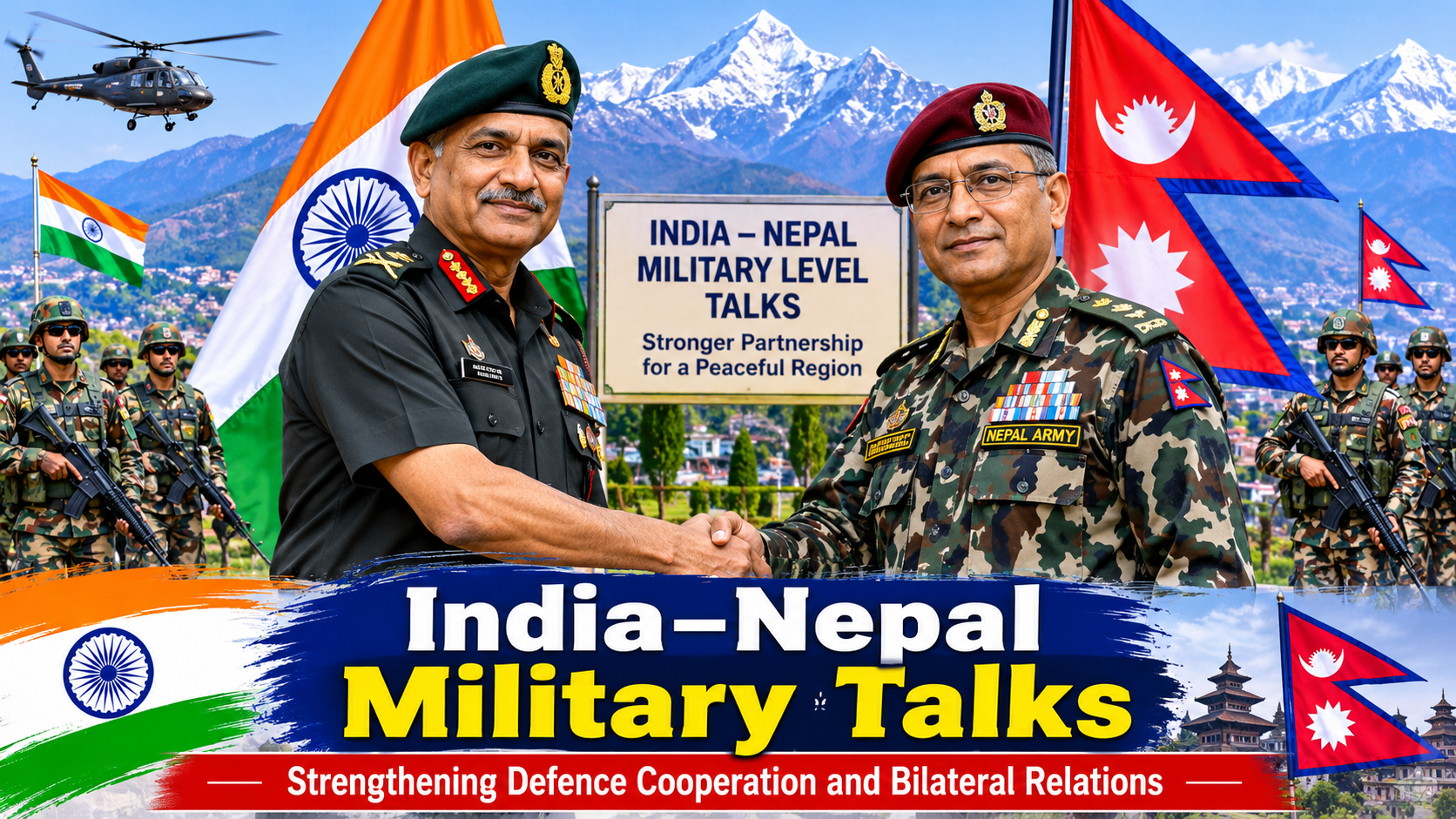
India–Nepal Military-Level Talks: Strengthening Defence Cooperation and Bilateral Relations
Contents
India and Nepal share a long-standing relationship built on historical connections, geographical proximity, cultural ties and cooperation in several sectors. Military-level talks between India and Nepal play an important role in maintaining bilateral relations, strengthening defence cooperation, promoting peace and improving coordination between the two neighbouring countries. Their defence relationship is supported by regular discussions, military exchanges, joint training programmes and cooperation in areas of mutual interest.
India and Nepal have a unique relationship because they share an open border and close social and economic connections. Both countries have a common interest in regional peace, security, stability and development. Military dialogue provides an important platform for officials to discuss defence-related cooperation, exchange views and maintain communication.
India–Nepal Military Talks and Defence Cooperation
India and Nepal continue to strengthen their military and diplomatic relationship through official visits, defence dialogue, training exchanges and bilateral cooperation. Recent developments have highlighted the importance of maintaining close communication between the two countries.
1. Background of India–Nepal Military Relations
India and Nepal have maintained close military relations for many decades. Their cooperation is supported by historical connections, mutual respect and shared interests in maintaining regional peace and stability. The two countries have developed several institutional mechanisms to discuss defence, security and military-related matters.
Military-level talks provide opportunities for defence officials to exchange views, review cooperation and identify areas where collaboration can be strengthened. These discussions are part of the wider bilateral relationship between India and Nepal.
2. Recent Developments in Defence Cooperation
India and Nepal have continued their high-level engagement during 2026. Indian Army Chief General Dhiraj Seth visited Nepal in August 2026 to strengthen military-to-military relations and discuss issues of mutual interest with Nepalese leadership. His visit highlighted the importance of regular communication between the two armies.
In November 2026, the Prime Ministers of India and Nepal also held high-level talks in New Delhi covering broader bilateral cooperation, regional matters and development priorities. These discussions reflected the continuing efforts of both governments to strengthen their partnership.
3. Importance of Military-Level Talks
Military-level talks are important for building trust, improving communication and strengthening institutional relationships between defence organisations. India and Nepal can use these discussions to review existing arrangements, exchange professional experiences and identify future opportunities for cooperation.
Regular dialogue can also help both sides address misunderstandings, maintain diplomatic communication and support a stable relationship between neighbouring countries.
4. Joint Training and Military Exchanges
India and Nepal have a tradition of joint military training and professional exchanges. These activities help personnel from both countries learn from one another, build professional relationships and understand different military institutions.
Joint military exercises are also an important part of bilateral defence cooperation. The annual exercise SURYAKIRAN reflects the continuing engagement between the two armies. The 20th edition of the exercise began in Nepal on 25 November 2026, according to India’s Ministry of Defence.
Such exchanges contribute to mutual understanding, discipline, professional development and cooperation between the armed forces.
5. Border Management and Security Cooperation
India and Nepal share an open border and extensive people-to-people connections. Cooperation between the relevant authorities is important for addressing cross-border concerns, supporting lawful movement and maintaining effective communication.
Both countries have held meetings focused on border management and security cooperation. These discussions are intended to improve coordination between relevant institutions and strengthen cooperation in areas of mutual interest.
The relationship also includes wider cooperation involving law enforcement, public administration and other government institutions.
6. Disaster Management and Humanitarian Cooperation
Disaster management is another important area of cooperation between India and Nepal. Both countries face natural challenges, including floods, landslides, earthquakes and other emergencies.
Cooperation in humanitarian assistance, emergency coordination and disaster response can help communities affected by natural disasters. India and Nepal have previously worked together on relief-related efforts and continue to recognise the importance of cooperation in disaster management.
Military and government institutions can contribute to humanitarian assistance and emergency support when requested by the relevant authorities.
7. Regional Peace and Stability
India and Nepal share an interest in maintaining peace and stability in South Asia. Their geographical proximity and economic connections make cooperation important for both countries.
Military dialogue can contribute to broader diplomatic engagement by encouraging communication, mutual understanding and confidence. Strong bilateral relations can also support cooperation in development, trade, transportation, energy and cultural exchanges.
Both countries have an interest in building constructive relationships with neighbouring countries and promoting peaceful solutions to regional issues.
8. Future of India–Nepal Defence Relations
The future of India–Nepal defence cooperation will depend on continued dialogue, mutual respect and cooperation between institutions. Regular meetings, professional exchanges, humanitarian collaboration and joint training can contribute to strengthening the relationship.
Both countries may continue exploring opportunities for cooperation while respecting each other’s national interests and priorities. Defence dialogue will remain one component of the wider partnership between India and Nepal.
Conclusion
India–Nepal military-level talks are an important part of the bilateral relationship between the two neighbouring countries. Their defence cooperation is supported by historical ties, military exchanges, official visits and discussions on shared interests.
Recent developments in 2026 demonstrate that both countries continue to engage through diplomatic and military channels. Through regular communication, cooperation and mutual respect, India and Nepal can continue strengthening their relationship and contributing to regional peace, stability and development.