
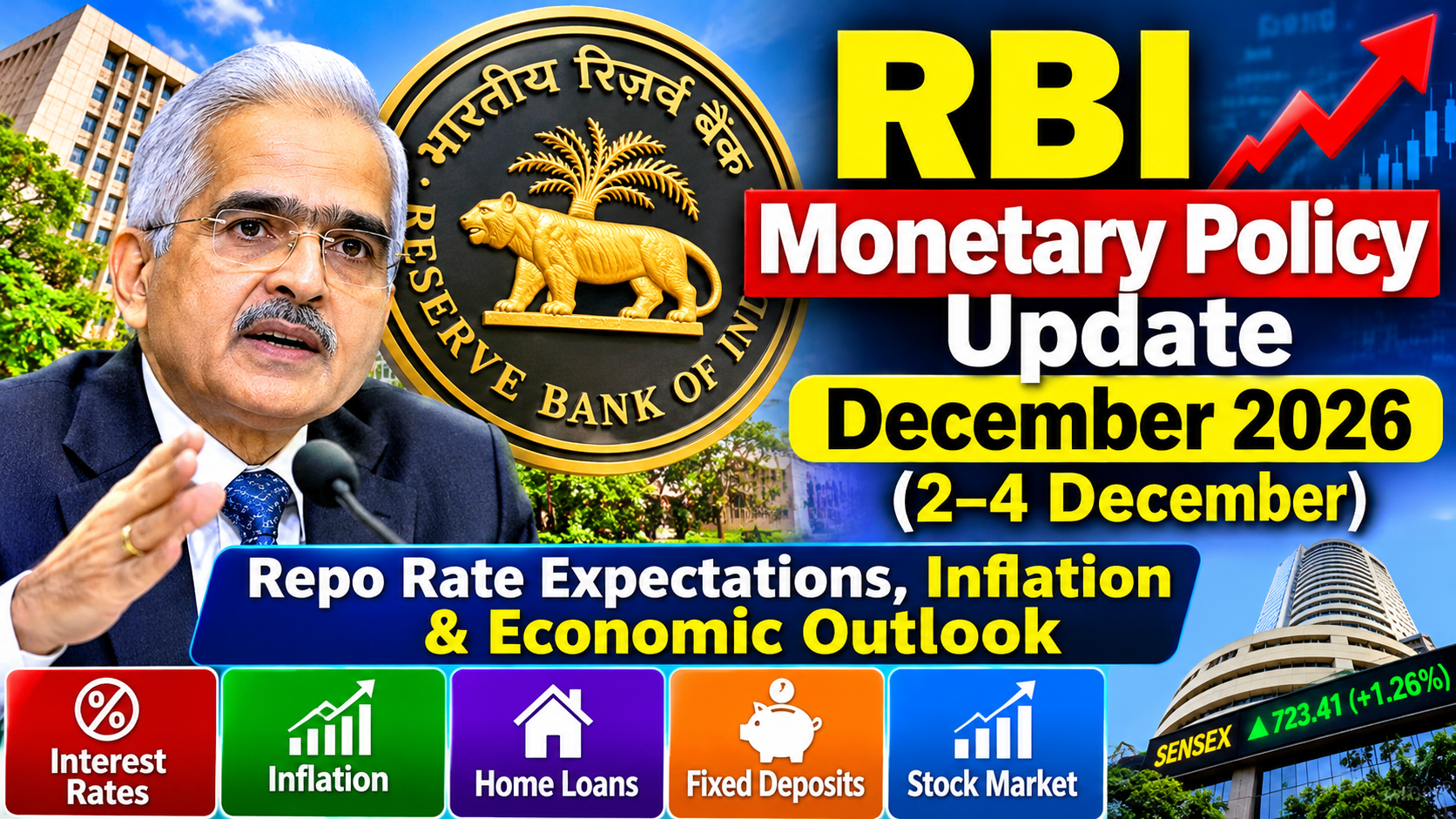
RBI Monetary Policy Update: Key Expectations for the December 2026 Meeting
Contents
The Reserve Bank of India (RBI) is expected to attract significant attention from financial markets, businesses, investors and borrowers as its monetary policy meeting approaches in early December 2026. The meeting, reportedly scheduled around 2–4 December, could bring important discussions about inflation, interest rates, economic growth, liquidity and the overall financial outlook for India.
The RBI’s monetary policy decisions play an important role in shaping India’s economy. Changes in the policy interest rate, banking liquidity and monetary policy guidance can influence loan costs, savings returns, investment decisions and financial market sentiment. As a result, the upcoming policy announcement could become one of the important economic developments to watch in December.
RBI Monetary Policy Meeting Schedule
The Reserve Bank of India has officially scheduled its Monetary Policy Committee (MPC) meeting for 2, 3 and 4 December 2026. The committee will review economic and financial conditions before announcing its policy decision.
The RBI’s October 2026 policy decision raised the repo rate by 25 basis points to 5.50% and adopted a calibrated tightening stance. This makes the upcoming December meeting particularly important for understanding the central bank’s next steps.
Why the RBI Monetary Policy Meeting Matters
The RBI’s monetary policy is one of the most important tools used to manage inflation and support economic stability. The policy decision can influence the cost of borrowing, banking operations, financial markets and economic activity across the country.
The Monetary Policy Committee mainly focuses on maintaining price stability while keeping economic growth in mind. It reviews several indicators, including consumer inflation, economic growth, liquidity conditions, global financial developments and domestic demand.
The December meeting is expected to receive attention because inflationary pressures and economic conditions could influence the committee’s decision.
1. Interest Rate Decision: What Could Happen?
Markets are watching for a possible rate hike.
The policy repo rate is the interest rate at which the RBI lends short-term funds to banks against eligible securities. Changes in this rate can influence the interest rates offered or charged by banks and financial institutions.
Following the October policy decision, the repo rate stands at 5.50%. Economists and market participants are closely watching whether the RBI will raise the rate further, maintain the current level or signal additional policy adjustments.
Recent reports suggest that inflationary pressures have increased expectations of another rate hike, although the final decision will depend on the MPC’s assessment.
2. Inflation Remains a Major Concern
Inflation is one of the key factors that the RBI considers when making monetary policy decisions. Rising prices of food, fuel, transport and other essential goods can affect household budgets and purchasing power.
The RBI generally aims to maintain consumer price inflation at 4%, with a tolerance band of 2% to 6%. Recent inflation data has become an important factor in the December policy outlook.
If inflation remains elevated, the RBI may consider tighter monetary conditions to reduce inflationary pressures. However, policymakers must also consider the potential impact of higher interest rates on economic growth and borrowing.
3. Impact on Home Loans, Personal Loans and Borrowers
The December monetary policy announcement could be important for people who have loans or are planning to borrow money.
If the RBI increases the repo rate, banks may adjust their lending rates depending on their funding costs, loan structures and other factors. Borrowers with repo-linked floating-rate loans could experience changes in their interest rates or repayment schedules.
Potential impacts include:
-
Home loans: Floating-rate borrowers may face higher interest costs if lending rates rise.
-
Personal loans: Banks and financial institutions could reassess borrowing rates and lending conditions.
-
Business loans: Companies may face increased financing costs if borrowing rates adjust upward.
-
New borrowers: People planning to take loans may closely monitor banking rates and lending policies.
The actual impact will depend on the lender, loan agreement, benchmark rate and the speed at which banks pass on policy changes.
4. Impact on Savings Accounts and Fixed Deposits
The RBI’s monetary policy can also influence savings products, including fixed deposits and other bank deposit schemes.
When interest rates rise, banks may offer more attractive rates on certain fixed deposits to attract funds. However, deposit rates do not always change immediately or uniformly across banks.
Customers planning to invest in fixed deposits may pay attention to the December policy announcement and subsequent bank updates. Savings account rates may also vary depending on the banking institution and account type.
5. Stock Market and Financial Sector Outlook
The Indian stock market could react to the RBI’s monetary policy announcement. Banking stocks, financial institutions, automobile companies, real estate businesses and other interest-sensitive sectors may be affected by changes in borrowing costs and economic expectations.
Higher interest rates can increase financing costs for businesses and consumers, potentially affecting investment and spending. On the other hand, stable monetary policy can provide greater predictability for financial markets.
Market reactions will depend not only on the rate decision but also on the RBI Governor’s statement, inflation outlook, liquidity measures and guidance about future policy.
Investors and market participants will therefore be watching the announcement closely.
6. Economic Growth and Business Activity
India’s economic growth is another important consideration for the RBI. Monetary policy decisions must balance inflation management with the broader economic outlook.
Higher borrowing costs can reduce some types of consumption and investment, while stable financial conditions may help businesses plan expansion and manage operations.
Small businesses, manufacturing companies, startups, housing-related industries and service-sector enterprises may pay attention to the policy announcement because financing costs can influence business decisions.
The RBI’s communication regarding growth, inflation and liquidity will be important for understanding the economic outlook for the coming months.
7. What to Expect on 4 December 2026?
The final day of the December MPC meeting, 4 December, is expected to be the key date for the monetary policy announcement. The decision and accompanying statement could provide insight into the RBI’s approach to inflation, interest rates and financial stability.
No December policy decision has been announced yet as of 29 November 2026.
Readers should check the official Reserve Bank of India website for the confirmed policy statement, repo rate, monetary policy stance and Governor’s remarks.
Conclusion
The RBI Monetary Policy Meeting scheduled for 2–4 December 2026 is an important upcoming economic event in India. The decision could influence borrowing costs, fixed deposit rates, stock market sentiment, banking activities and business expectations.
Inflation, economic growth, liquidity conditions and global financial developments are expected to remain among the major factors influencing the MPC’s decision.
As the announcement approaches, borrowers, businesses, financial institutions and market observers will be watching for updates from the Reserve Bank of India. The policy decision may provide a clearer picture of India’s monetary policy direction heading into the final weeks of 2026.