
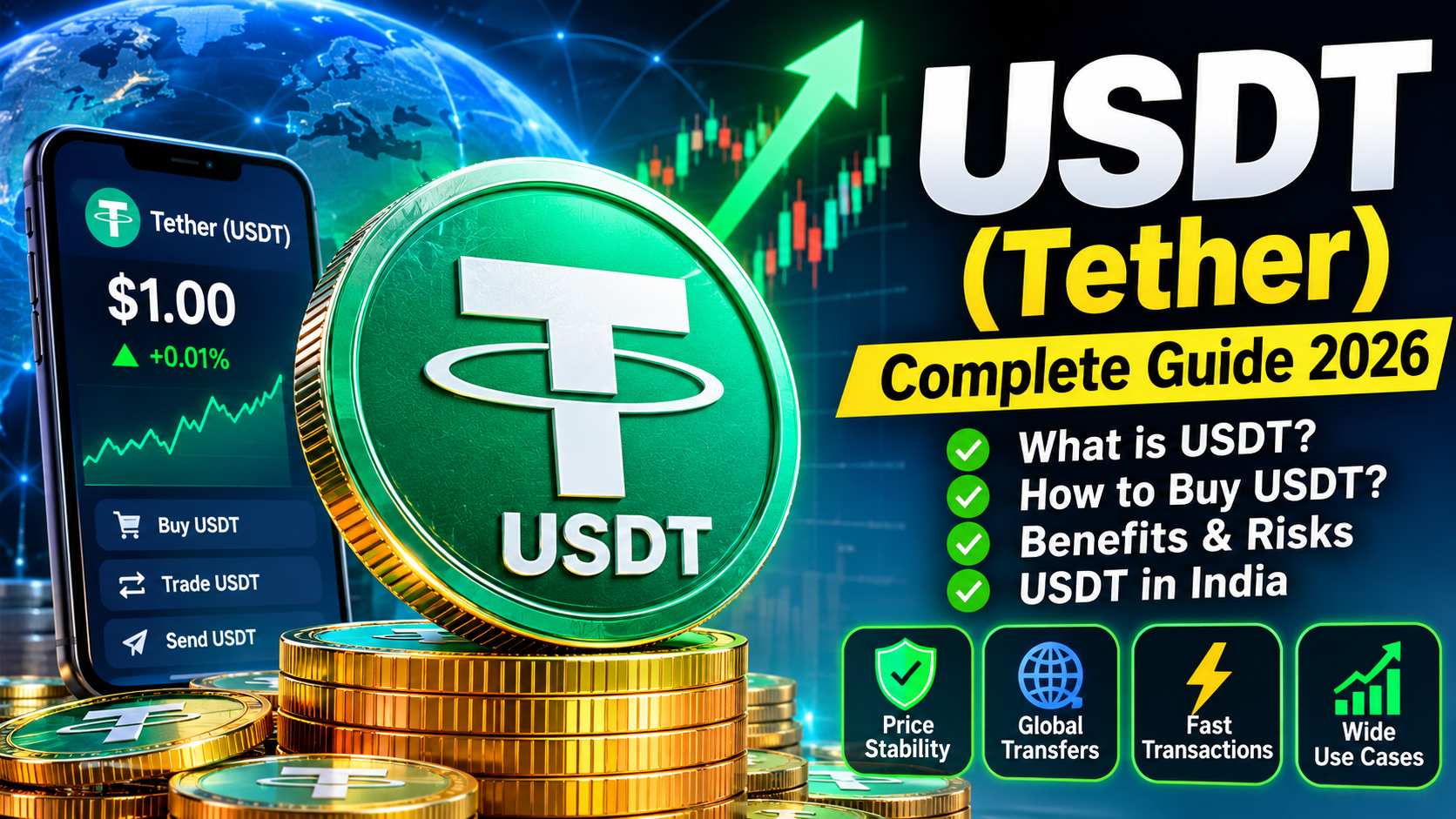
USDT (Tether) Complete Guide 2026: Price, Uses, Benefits, Risks and How to Buy
Contents
Introduction
Cryptocurrency has become an important part of the modern digital financial world. Thousands of cryptocurrencies are available in the market, including Bitcoin, Ethereum, Solana and many other digital assets. Among these cryptocurrencies, USDT (Tether) has become one of the most widely used digital currencies.
USDT is a stablecoin designed to maintain a value close to one US dollar. Unlike Bitcoin and other cryptocurrencies, which can experience significant price movements, USDT aims to provide greater price stability.
In 2026, USDT continues to play an important role in cryptocurrency trading, digital payments and blockchain-based financial services. Many cryptocurrency users use USDT to transfer digital value, trade other cryptocurrencies and temporarily hold funds without directly converting them into traditional currencies.
In this article, we will explain what USDT is, how it works, its benefits, risks, buying methods and future opportunities.
What Is USDT?
USDT stands for United States Dollar Tether. It is a digital stablecoin issued by Tether, a company that provides blockchain-based digital tokens.
The main purpose of USDT is to maintain a value equivalent to one US dollar. In simple terms, one USDT is designed to represent approximately one US dollar.
For example:
- 1 USDT = approximately $1
- 10 USDT = approximately $10
- 100 USDT = approximately $100
- 1,000 USDT = approximately $1,000
However, the market price can sometimes move slightly above or below one dollar because of market demand, liquidity and trading conditions.
USDT is available on multiple blockchain networks, making it useful for cryptocurrency exchanges, digital wallets and other blockchain applications.
How Does USDT Work?
USDT operates through blockchain technology. When someone sends USDT to another person, the transaction is recorded on the selected blockchain network.
Tether states that issued USDT tokens are backed by reserves. These reserves include traditional currency, cash equivalents and other assets.
The company publishes information about its reserves and circulating tokens through its official transparency platform.
The basic process works as follows:
- A customer purchases USDT through a supported service.
- USDT tokens are issued or transferred to the customer’s wallet.
- The customer can hold, transfer or trade the tokens.
- USDT can be transferred to another compatible wallet.
- Eligible verified customers may redeem USDT through Tether under its applicable terms and conditions.
This system allows users to move dollar-pegged digital tokens through supported blockchain networks.
Popular Blockchain Networks Supporting USDT
One important feature of USDT is its availability across different blockchain networks.
Some popular networks include:
1. TRON Network
USDT on TRON is commonly known as TRC-20 USDT. It is widely used for transfers between cryptocurrency wallets and exchanges.
2. Ethereum Network
USDT is also available as an ERC-20 token on Ethereum. This network supports smart contracts and decentralized applications.
3. Solana Network
Solana supports USDT transfers through its blockchain ecosystem. Its high transaction capacity makes it useful for various digital financial applications.
4. TON Network
USDT is also supported on The Open Network, providing another option for blockchain-based transfers.
5. Other Supported Networks
USDT has also been issued on other supported blockchain protocols. Users should always check Tether’s official supported-protocol information before transferring tokens.
Important: Always select the same network on the sending and receiving platforms. Sending USDT through an unsupported or incorrect network can result in permanent loss of funds.
Main Benefits of USDT
USDT offers several advantages that make it popular among cryptocurrency users.
1. Price Stability
USDT aims to maintain a value close to one US dollar. This makes it different from highly volatile cryptocurrencies.
2. Easy Cryptocurrency Trading
Many cryptocurrency exchanges offer trading pairs involving USDT. Traders can use it to exchange Bitcoin, Ethereum and other digital assets.
3. International Transfers
USDT can be transferred across supported blockchain networks without using traditional banking transfer systems for every transaction.
However, availability, fees and legal requirements depend on the countries and services involved.
4. Multiple Blockchain Options
Users can choose from supported blockchain networks depending on exchange compatibility, transaction fees and transfer requirements.
5. Digital Wallet Support
USDT can be stored in compatible cryptocurrency wallets, including supported exchange wallets and self-custody wallets.
How to Buy USDT in 2026
Buying USDT requires selecting a trustworthy and legally compliant cryptocurrency service.
Here is a general process:
Step 1: Choose a Cryptocurrency Platform
Research a cryptocurrency exchange that supports USDT and is permitted to serve customers in your jurisdiction.
Step 2: Create an Account
Register using the required information and complete identity verification if requested.
Step 3: Check Deposit Methods
Review the available payment methods, fees and withdrawal conditions.
Step 4: Purchase USDT
Select USDT, enter the amount and carefully review the exchange rate and transaction charges.
Step 5: Store Your USDT
You can keep your USDT in a supported exchange wallet or transfer it to a compatible personal wallet.
Always verify the destination address and blockchain network before confirming a transaction.
USDT in India: Important Information
USDT is relevant to Indian cryptocurrency users who participate in digital asset markets.
However, cryptocurrency transactions in India involve important legal, tax and compliance considerations.
In a February 2026 parliamentary response, the Ministry of Finance stated that virtual digital assets remain unregulated in India. The government has also brought virtual digital asset service providers within the Financial Intelligence Unit-India framework for anti-money-laundering and counter-terrorism-financing obligations.
Users should understand that this does not mean every cryptocurrency activity is automatically prohibited or that cryptocurrency investments receive government protection.
Before buying or selling USDT in India, users should:
- Check the applicable Indian tax rules.
- Use platforms that meet relevant compliance requirements.
- Understand transaction reporting obligations.
- Maintain purchase and sale records.
- Check applicable foreign-exchange and cross-border payment rules.
- Avoid unverified sellers and suspicious investment schemes.
Consult a qualified tax professional for advice about individual transactions.
Risks of Investing in USDT
Although USDT is designed to maintain a stable price, it is not completely risk-free.
1. Depegging Risk
USDT can temporarily trade below or above one US dollar. Market stress or liquidity problems can affect its price.
2. Issuer Risk
USDT depends on Tether’s ability to manage its reserves and meet applicable redemption obligations.
3. Regulatory Risk
Cryptocurrency regulations can change across different countries. New rules may affect how users buy, sell, transfer or store USDT.
4. Wallet Security Risk
If someone gains access to your private keys or recovery phrase, your digital assets may be stolen.
5. Wrong Network Transfers
Sending USDT to an incompatible wallet or using the wrong blockchain network can cause irreversible losses.
6. Scams and Fraud
Fake investment platforms, fraudulent websites and people promising guaranteed profits are common risks in the digital asset market.
Never share your wallet recovery phrase, private keys or account passwords.
USDT vs Bitcoin: What Is the Difference?
USDT and Bitcoin have different purposes.
Bitcoin is a cryptocurrency with a market-driven price. Its value can increase or decrease significantly.
USDT is a stablecoin designed to follow the value of the US dollar.
Bitcoin is often used as a digital asset for investment and payments, while USDT is commonly used for trading, transfers and maintaining dollar-denominated value within cryptocurrency markets.
Neither asset guarantees profits or protection against financial loss.
Future of USDT in 2026 and Beyond
The future of USDT will depend on cryptocurrency adoption, international regulations, blockchain development and confidence in its reserve management.
Stablecoins may continue to play an important role in digital payments, cryptocurrency exchanges and decentralized finance.
USDT’s availability across multiple blockchain networks gives it flexibility within the digital asset ecosystem.
At the same time, stronger regulations and increased transparency requirements could influence how stablecoins operate in the coming years.
Users should follow official Tether announcements, reserve reports and government regulations rather than relying on social media rumours or guaranteed-profit claims.
Conclusion
USDT (Tether) is one of the most important stablecoins in the cryptocurrency market. Its goal of maintaining a value close to one US dollar makes it useful for cryptocurrency trading, blockchain transfers and digital asset management.
It offers benefits such as multiple blockchain networks, exchange availability and convenient digital transfers. However, users must also understand issuer, regulatory, security and depegging risks.
Before purchasing USDT, research the platform, check the network, understand applicable taxes and protect your wallet credentials.
USDT can be a useful digital financial tool, but it should never be considered completely risk-free or a guaranteed investment.
Disclaimer: This article is for educational and informational purposes only. It is not financial, investment, legal or tax advice. Always conduct independent research before making cryptocurrency transactions.