
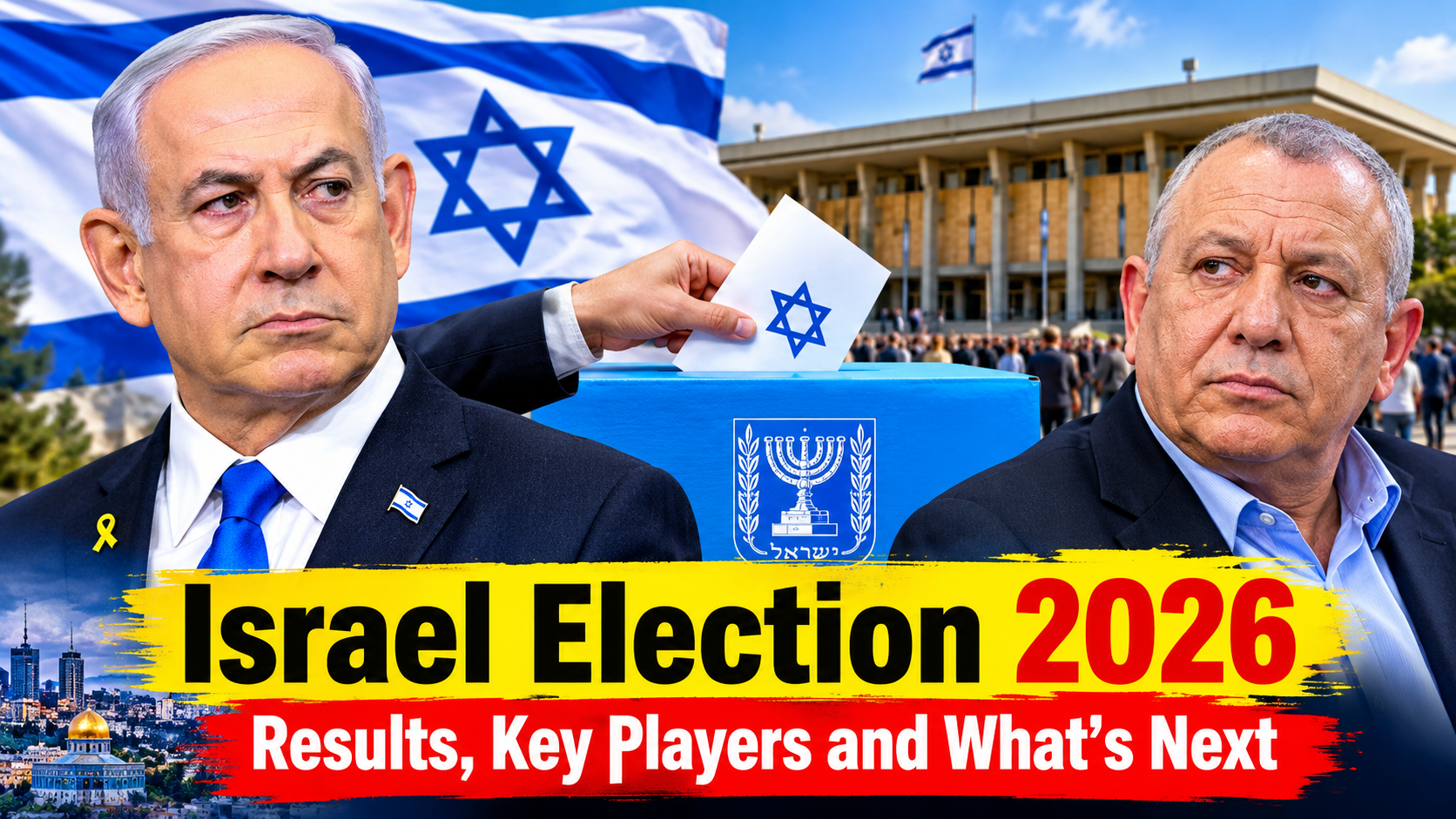
Israel Election 2026: Latest Results and the Battle to Form a New Government
Contents
Israel’s 2026 general election has become one of the most significant political events in the Middle East. The election took place on October 27, 2026, with voters choosing representatives for the country’s 120-member parliament, known as the Knesset. The contest attracted international attention because of Prime Minister Benjamin Netanyahu’s political future, ongoing regional conflicts and growing public debate about national security and government accountability.
The election has now produced a complicated political situation. Although Netanyahu’s Likud party secured the highest number of seats, neither his political bloc nor the opposition secured the 61 seats required to form a majority government. Former military chief Gadi Eisenkot has emerged as a major opposition figure, making the next stage of government formation particularly important.
Israel Election 2026: What Happened?
Israel held its general election on October 27, 2026. The election was important because it was the first national vote since the October 7, 2023 Hamas attack and the subsequent regional conflicts that significantly affected Israeli politics.
The election also marked an important moment for Israel’s democratic system. Voters had to consider the government’s performance, security policies, economic conditions and the country’s international relationships.
Prime Minister Benjamin Netanyahu’s leadership was one of the central subjects of the campaign. His supporters highlighted his political experience and security policies, while opposition parties called for political change and greater accountability.
The final political picture showed a divided parliament, with several political groups holding enough seats to influence negotiations.
Israel Election Results 2026: Party-Wise Seats
The election results did not give any political bloc an outright majority. The Knesset has 120 seats, and a government generally needs support from at least 61 lawmakers.
The reported seat distribution is:
| Political party or bloc | Seats |
|---|---|
| Likud | 27 |
| Yashar | 21 |
| Joint List | 11 |
| B’Yachad | 12 |
| The Democrats | 8 |
| Ra’am | 8 |
| United Torah Judaism | 7 |
| Yisrael Beytenu | 7 |
| Otzma Yehudit | 7 |
| Shas | 6 |
| Religious Zionism | 6 |
The pro-Netanyahu bloc secured 53 seats, while the main opposition bloc led by Eisenkot secured 48. Arab-led parties secured 19 seats.
These results demonstrate why coalition negotiations are so important. Neither of the two main political blocs can independently establish a majority government.
Benjamin Netanyahu and His Political Future
Benjamin Netanyahu remains one of the most influential figures in Israeli politics. He has served as prime minister during several periods and is the country’s longest-serving prime minister.
However, the 2026 election has created serious challenges for his political future. Although Likud won 27 seats and finished as the largest individual party, its wider coalition secured only 53 seats.
Netanyahu’s supporters want him to continue leading the government, while opposition politicians believe the election provides an opportunity for a new political direction.
His leadership has also faced questions about the government’s handling of national security and the events surrounding October 7, 2023. His ongoing corruption trial has remained another important subject in the political debate.
For Netanyahu, the next stage will depend on coalition negotiations and whether he can secure enough parliamentary support to remain prime minister.
Gadi Eisenkot: A Major Opposition Leader
Gadi Eisenkot has become an important figure following the election.
Eisenkot, a former chief of the Israel Defense Forces, leads the centrist Yashar party. His political position has attracted voters looking for an alternative to Netanyahu’s government.
The opposition bloc secured 48 seats, while Arab-led parties won another 19 seats. This has made cooperation between different political groups a major issue in the government formation process.
According to reporting on November 5, 67 lawmakers backed Eisenkot during consultations with President Isaac Herzog, compared with 46 who backed Netanyahu. However, parliamentary endorsements do not automatically guarantee that either leader can form a stable government.
Major Issues Behind the Israel Election
Several important issues influenced the 2026 election.
1. National Security
National security was one of the biggest subjects during the election campaign. Israel has experienced major security challenges since the October 7, 2023 attack and the conflicts that followed.
Voters have been debating military policy, border security, intelligence operations and the government’s ability to protect citizens.
Different political parties have presented different approaches to national security. The next government will face pressure to establish policies that address these challenges.
2. Gaza and Regional Conflicts
The situation in Gaza and wider Middle Eastern tensions have played a major role in Israeli politics.
The conflicts involving Hamas, Hezbollah and Iran have influenced public opinion, international diplomacy and Israel’s security priorities.
The next government will need to address regional stability, diplomatic relationships and the future of negotiations involving neighbouring countries and international partners.
3. Government Accountability
Another major issue was accountability for the security failures associated with October 7, 2023.
Opposition parties have demanded answers about the government’s decisions and its handling of national security before and after the attack.
This issue remains politically sensitive and could influence the decisions of lawmakers during coalition negotiations.
4. Military Service and Religious Exemptions
Military service has also become a major political issue.
Debate over exemptions for ultra-Orthodox Jewish men has created disagreements between religious parties and other political groups.
Some parties want changes to existing arrangements, while religious political groups want to protect the current system. The issue could become an important condition in negotiations to form the next government.
5. Economy and Cost of Living
Economic conditions are another important concern for Israeli voters.
The cost of living, employment opportunities, housing affordability, public spending and the economic effects of regional conflicts remain significant political topics.
The next government will need to consider policies that support economic stability while addressing national security and public services.
Role of President Isaac Herzog in Government Formation
Isaac Herzog, the President of Israel, has an important constitutional responsibility following the election.
After consulting political representatives, the president selects a member of the Knesset who appears most likely to form a government.
According to reports published on November 5, Herzog was expected to select a candidate on Sunday, November 8, 2026. The selected candidate will initially receive 28 days to form a government, with a possible additional 14-day extension.
The negotiations could involve several political parties, including groups that previously disagreed over government policies.
Herzog has also encouraged political leaders to find a solution rather than force the country into another election.
Why Arab-Led Parties Could Become Important
One of the notable developments in the 2026 Israel election was the performance of Arab-led political parties.
These parties secured a combined 19 seats in the Knesset, making them potentially influential in determining which political group can form a government.
The Joint List and Ra’am have become important participants in the post-election political discussion.
However, cooperation is complicated because several mainstream Jewish opposition parties have previously rejected formal political partnerships with Arab-led parties.
The election has therefore created an important question: Can different political groups cooperate despite their ideological differences?
The answer could determine whether Israel forms a new government quickly or faces another period of political uncertainty.
International Reactions and Global Importance
The Israel election has attracted international attention because the country’s political decisions have significant consequences beyond its borders.
The United States, European countries and Middle Eastern governments closely follow Israeli political developments.
Israel’s relationship with the United States is particularly important because of military cooperation, diplomatic relations and regional security.
European governments are also interested in the future direction of Israeli foreign policy, particularly regarding Gaza, the West Bank and the possibility of a broader regional peace process.
A new government could introduce changes to diplomatic priorities, security policies and international negotiations.
What Happens Next After Israel Election 2026?
The coming days will be extremely important for Israeli politics.
The president’s decision on November 8 is expected to begin another stage of political negotiations. The selected candidate must demonstrate that enough lawmakers are prepared to support a new government.
Three possible developments could shape Israel’s political future:
-
Netanyahu returns to power: If he successfully negotiates additional support, he could continue as prime minister.
-
Eisenkot forms a government: The opposition leader could attempt to bring together different political groups and secure parliamentary support.
-
Another election becomes necessary: If no candidate can establish a workable government, Israel could face another election in the future.
At present, none of these outcomes should be treated as certain.
Conclusion: Israel Election 2026 Could Change the Country’s Political Future
The Israel Election 2026 has created a new chapter in the country’s political history. Benjamin Netanyahu’s Likud party finished as the largest individual party, but the election did not provide his coalition with the majority needed to govern.
Gadi Eisenkot has emerged as a major challenger, while Arab-led political parties could play an important role in determining the next government.
The upcoming coalition negotiations will be crucial for Israel’s political stability, national security, economy and international relationships.
As of November 6, 2026, the country is still waiting for the next stage of government formation. The decisions made over the coming days could determine whether Israel gets a new political leadership arrangement or faces another election.
For international observers, the Israel election remains an important development to follow because its outcome could influence politics and diplomacy across the Middle East.